Main Shut Off Valve Replacement: A Step-by-Step Guide for Plano Sprinkler Systems
Every in-ground sprinkler system in Plano depends on one part most homeowners never look at: the main shut off valve. It is the single point that cuts water to the entire irrigation system. When it corrodes, sticks, or will not seal, you lose the ability to stop a stuck zone, isolate a leak, or winterize before a freeze. If yours has failed, replacing it through irrigation shutoff valve replacement is a straightforward repair when you take it in order. This guide walks through the replacement step by step, and it is honest about which steps belong to a pro.
One note before the steps. On most Plano systems, the irrigation main shut off valve sits between the house supply line and the backflow preventer. It is separate from the main shut off valve for water in the house, which controls everything, not just the sprinklers. Some builder-installed systems skip the dedicated irrigation shutoff entirely, which is worth fixing while you are in there.
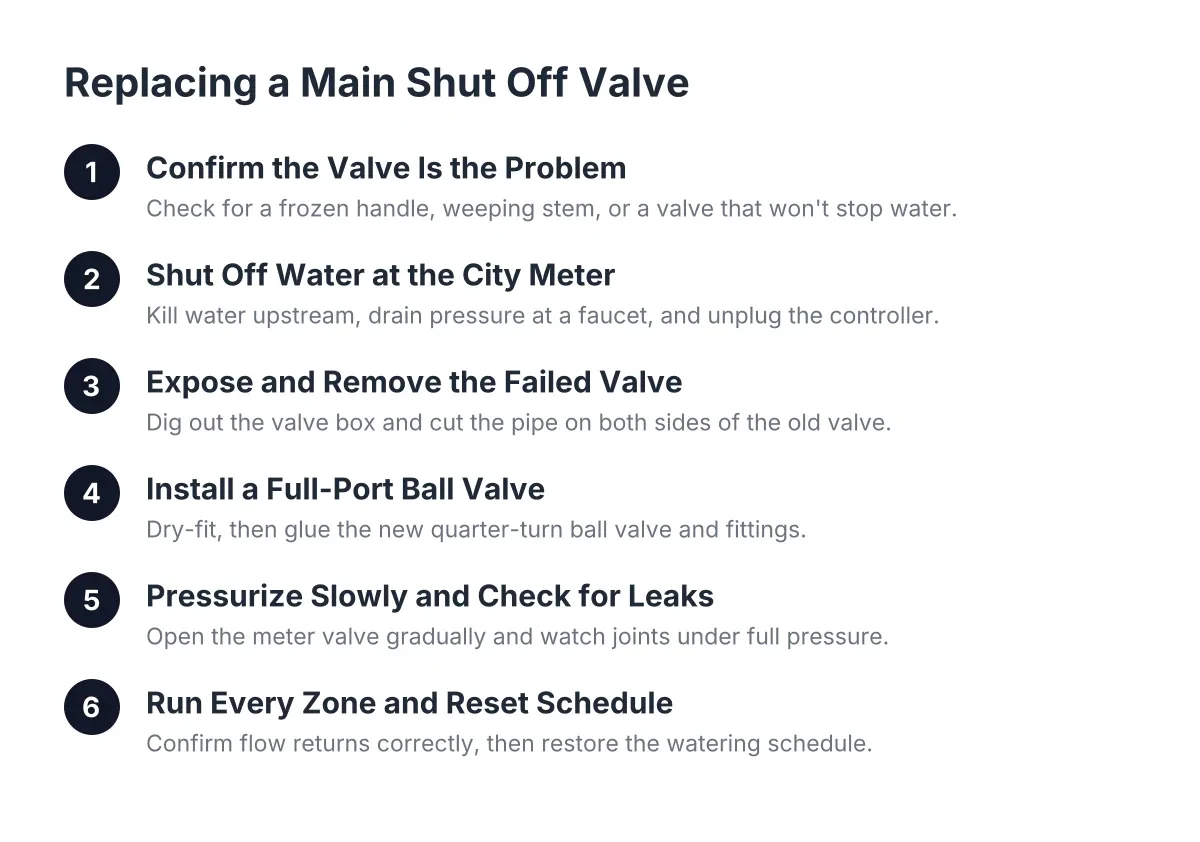
Step 1: Confirm the Valve Is Actually the Problem
Before you buy parts, make sure the shutoff valve itself has failed. The common failure signs are different from a zone valve problem.
- The handle will not turn, or it spins without stopping the water.
- You close the valve fully and water still reaches the sprinkler system; the main shut off valve doesn't stop water the way it should.
- Water weeps from the valve stem or body, often after a hard freeze.
- The handle has snapped off a corroded gate valve, a common sight on systems 15 to 25 years old.
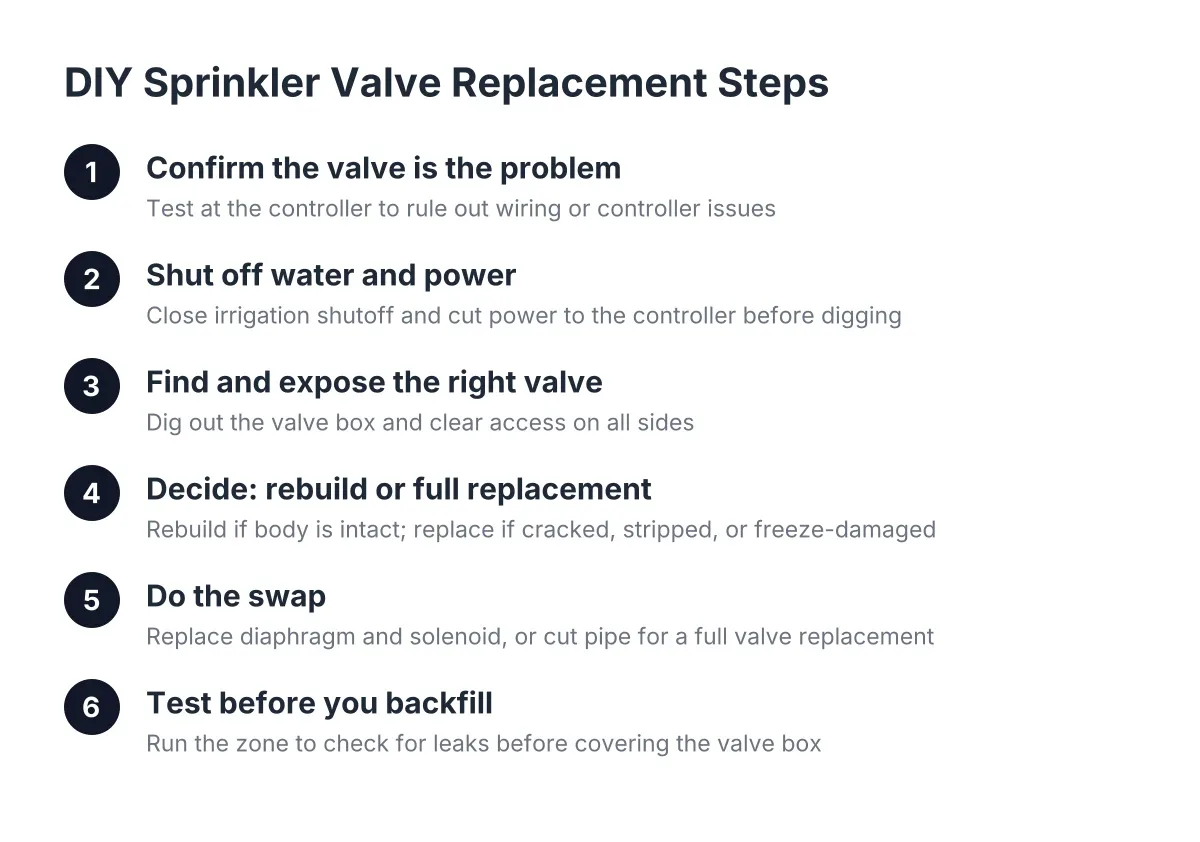
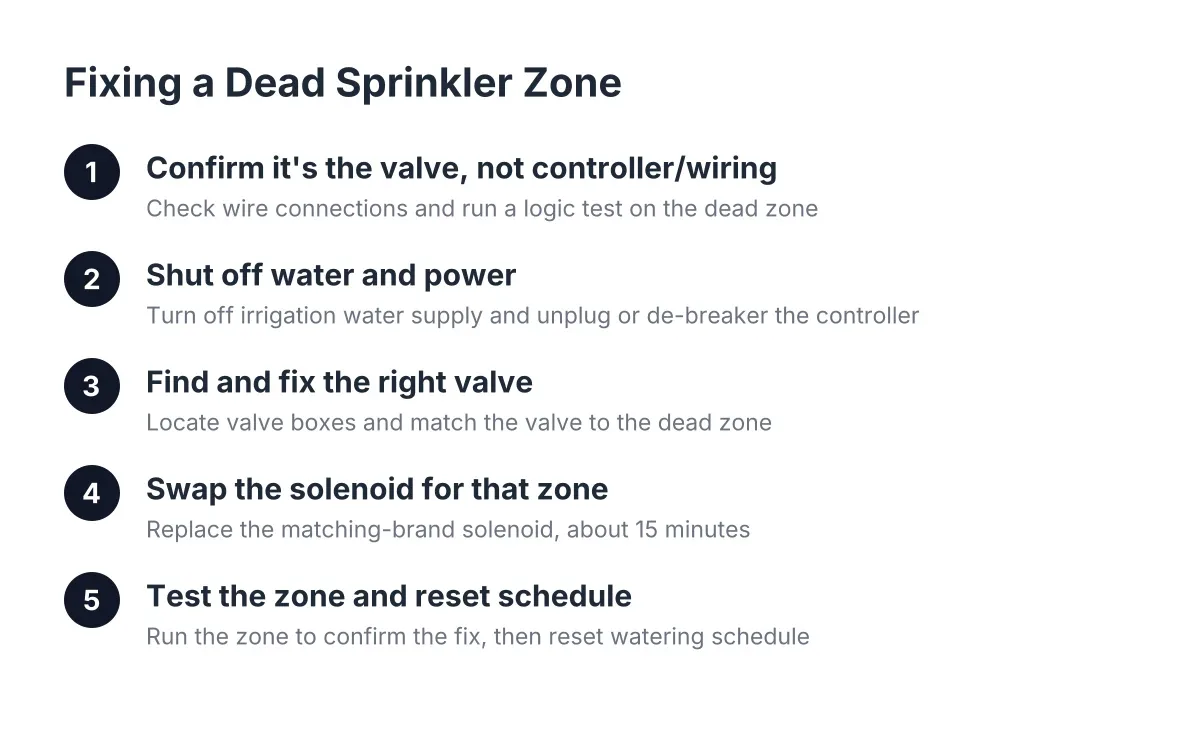
By contrast, a single zone that runs even when the controller is off points to a failed zone valve, not the shutoff. That is a sprinkler valve replacement at the valve box, a different repair with a different cost. If every zone behaves normally and only the shutoff leaks or sticks, you are in the right article.
For example, suppose a Plano homeowner doing a fall shutdown finds the shutoff handle frozen in place. A freeze warning is two days out, the backflow preventer needs draining, and the only working cutoff is the one for the whole house. In that scenario, the valve replacement is not optional; it is the step that makes every future startup and shutdown possible.
Step 2: Shut Off the Water Supply at the City Meter
Replacing the irrigation shutoff means working upstream of it, so you must kill water at the source. For most Plano homes, that is the city meter box near the curb or the house-side cutoff in the same box.
First, lift the meter box lid and locate the valve on the house side of the meter. Many take a simple quarter turn with a meter key, sometimes called a main shut off valve key, which hardware stores sell for a few dollars. A crescent wrench works in a pinch, but a key gives better grip on a stiff valve.
Next, open an outside faucet to drain pressure from the line. Wait until the flow stops completely. Working on a pressurized line is how a simple repair turns into a flooded trench, so never skip this check.
In addition, turn off the irrigation controller or unplug it. You do not want a programmed zone trying to open valves while the system is drained and opened up.
Step 3: Expose and Remove the Failed Shut Off Valve
Dig out the valve box or the soil around the valve until you have clear access to the pipe on both sides. In North Texas, that usually means working in heavy clay. Clay holds water against fittings and shifts with wet and dry cycles, which is one reason valves and pipes crack here in the first place. Give yourself room; a cramped hole leads to bad glue joints.
Then cut the pipe on each side of the old valve with a PVC cutter or hacksaw. Keep the cuts square and leave enough straight pipe to attach new fittings. If the old valve was threaded onto metal fittings, expect corrosion; penetrating oil and patience beat brute force, which can crack the pipe below.
Clean out the hole and sponge up standing water. Glue does not bond well on wet, muddy pipe, and a joint that fails in July means doing this all again in 100-degree heat.
Step 4: Install a Full-Port Ball Valve for Irrigation Shutoff Valve Replacement
This is where the repair becomes an upgrade decision. You have two main choices, and the trade-offs matter for how the valve ages in Plano conditions.
Gate valves, the kind with a round wheel handle, were standard on older systems. They are cheap, but the internal gate corrodes, sticks, and stops sealing after years of sitting in one position. Most failed irrigation shutoffs we are describing in this guide are gate valves.
Ball valves use a quarter-turn lever and a smooth ball that seals reliably even after years of disuse. A full-port ball valve does not choke flow, which protects pressure to your zones. For an irrigation shutoff that gets used twice a year, at spring startup and winter shutdown, the ball valve is the better match. The cost difference on the part is modest; the labor to replace it again is not.
Dry-fit everything first. Then prime and glue the new valve and fittings, hold each joint for 30 seconds, and let the glue cure per the label before pressurizing. Leave the new valve in the open position while gluing so solvent fumes do not damage the seals.
Step 5: Pressurize Slowly and Check the Main Shut Off Valve for Leaks
After the glue cures, turn the city meter valve back on slowly, about a quarter of the way at first. A slow fill prevents water hammer, the pressure spike that can crack a fresh joint or stress the backflow preventer.
Watch the new valve and both glue joints for several minutes under full pressure. A joint that seeps now will not heal itself. If you see a drip, shut the water back down and redo the joint; it is faster than digging again next month.
Finally, test the valve itself. Close it fully and confirm the sprinkler side loses pressure, then open a zone from the controller to confirm flow returns when the valve is open. A new shutoff that does not fully stop water means debris in the line or a bad part, and it needs to come back out.
Step 6: Run Every Zone and Reset Your Watering Schedule
With the new valve in service, run each zone from the controller for a few minutes. Watch for heads that do not pop up, weak coverage, or wet spots that suggest a line cracked while the system sat drained. A full pass now catches problems while you are already paying attention.
This is also the right moment to update your watering schedule for Plano's current restrictions and the season. A well-managed irrigation system can cut irrigation water use by 15 percent, or nearly 7,600 gallons a year, according to U.S. Environmental Protection Agency (EPA WaterSense). The same source notes a poorly maintained automatic system can waste up to 25,000 gallons annually. A working shutoff is what lets you catch and stop that waste instead of watching it show up on the bill.
If your controller is an older clock-based model, consider swapping it during the same visit. According to U.S. Environmental Protection Agency (EPA WaterSense), replacing a clock-based controller with a WaterSense labeled irrigation controller can cut an average home's irrigation water use by up to 30 percent, saving up to 15,000 gallons annually.
When to Hand the Irrigation Shutoff Valve Replacement Work to a Pro
Replacing an irrigation shutoff valve is a DIY-possible job for a confident homeowner with PVC experience. However, some situations call for a sprinkler system contractor instead.
- The valve ties into copper or galvanized pipe, which needs soldering or specialty fittings.
- You cannot find or operate the city meter valve, or the meter-side cutoff leaks.
- The backflow preventer also shows freeze damage; backflow work has local requirements and is not a casual repair.
- The system has no dedicated irrigation shutoff at all, and one needs to be added in the right spot.
As for cost, the replacement cost of a main shut off valve depends on access, pipe depth in that clay soil, pipe material, and whether the backflow preventer or zone valves need work in the same visit. A standalone shutoff swap sits at the low end of sprinkler system repair cost; pairing it with freeze-damaged backflow or valve work raises the total. Get the full scope diagnosed before the first freeze warning or the first warm week of spring 2026, whichever is coming at you next. The worst time to learn your shutoff is seized is the night the forecast drops below 32.
If you need sprinkler valve replacement, North Dallas Sprinkler Repair can help.
Prefer to talk it through? Call (469) 639-1022 — a quick call is usually the fastest way to get a straight answer for your situation.