Why Plano’s Clay Soil Requires a Different Sprinkler System Installation Method
If you are getting quotes for a new irrigation system in Plano, TX, here is the one thing most generic bids miss: Plano's clay soil requires installation methods that differ from what works in sandy or loamy ground. North Texas blackland clay swells when wet, shrinks hard when dry, and shifts enough through a single summer to crack a poorly bedded pipe. A system installed without accounting for that movement often starts leaking within a few seasons, and the proper cycle and soak watering approach prevents the first warning sign—a water bill that doubles with no visible flooding.
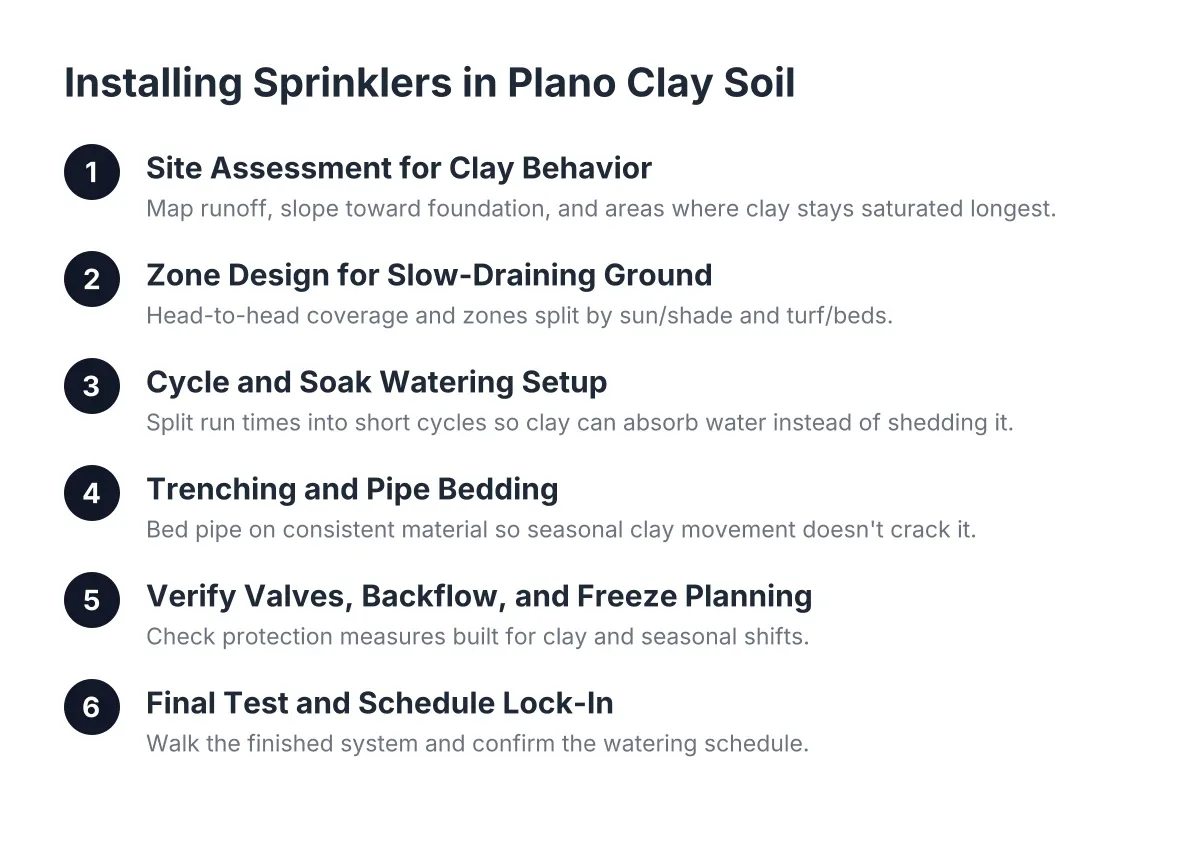
This guide walks through the installation process step by step, written for a homeowner who is ready to hire. At each step, you will see what a careful sprinkler system contractor does differently because of the clay, what questions to ask before you sign, and which shortcuts show up later as soggy patches, stuck valves, and mystery water bills.
One number worth knowing before the steps: a household with an automatic landscape irrigation system that is not properly maintained can waste up to 25,000 gallons of water annually, according to U.S. Environmental Protection Agency (EPA WaterSense). Much of that waste traces back to how the system was installed in the first place.
Step 1: Get a Site Assessment That Accounts for Clay Soil Behavior
Start by having the contractor walk the whole property before any design work begins. In Plano, this is not a formality. The assessment should map where water pools after rain, where the ground slopes toward the foundation, and where the clay stays saturated longest.
Why does this matter so much here? Clay absorbs water slowly. Spray a zone for 20 minutes straight and most of that water runs off instead of soaking in. A good installer plans shorter, repeated watering cycles around that, and a good design starts with knowing where runoff already goes.
Ask the contractor to flag these items during the walk:
- Low spots where water stands for more than a day after rain
- Grading that sends water toward the slab or the neighbor's lot
- Signs of past digging, like a visible seam in the lawn from cable or fiber installation
- Existing wet patches that might point to an old buried line or a drainage problem
That last point matters more than most homeowners realize. Vibratory plows used to bury cable can crimp a PVC line without severing it, leaving a hidden restriction or slow leak. If your lot has had utility work, say so during the assessment.
If the walk reveals standing water or foundation-adjacent pooling, talk through French drain installation before the sprinkler design is final. Trenching once for both jobs costs less than digging the yard up twice, and the drain layout affects where irrigation lines should run.
Step 2: Demand a Zone Design Built for Slow-Draining Ground
Next comes the design, and this is where Plano's clay soil requires the most judgment. The designer divides the yard into zones, each controlled by its own valve, and matches head types to each area. On clay, two design rules are non-negotiable.
First, head-to-head coverage. Each sprinkler's spray should reach the neighboring head so the whole zone gets even water. Gaps in coverage show up on clay as hard, cracked dry spots next to green stripes, and no watering schedule fixes a spacing problem.
Second, zones must separate sun from shade and turf from beds. Clay in full August sun dries into something close to brick; clay under a live oak stays damp for days. Lumping both into one zone means one area drowns while the other starves.
For reference on head anatomy, a rotor sprinkler consists of a body buried in the ground, a riser that rises from it, a turret that rotates during operation, and a nozzle at the top that sprays the water, according to Hunter Industries. Rotors typically cover the larger open turf areas, while smaller spray heads or drip lines handle beds and tight strips.
Why Plano's Clay Soil Requires Cycle and Soak Watering
Cycle and soak watering means splitting each zone's run time into two or three short cycles with a pause between them, so slow-draining clay can absorb the water instead of shedding it as runoff. On a Plano lawn, one 21-minute run might become three 7-minute cycles. The grass gets the same water; the gutter does not.
Your controller choice decides how easy this is to manage. A smart controller handles split cycles and skips watering after rain automatically. Replacing a clock-based irrigation controller with a WaterSense labeled controller can cut an average home's irrigation water use by up to 30 percent, saving up to 15,000 gallons annually, according to U.S. Environmental Protection Agency (EPA WaterSense). The controller also needs to respect Plano's watering-restriction schedule, which limits which days and hours you can run the system.
Step 3: Watch How the Crew Trenches and Beds the Pipe
Trenching is where clay punishes sloppy work. The crew cuts trenches for the main line and the zone laterals, and in blackland clay those trenches are heavy, sticky going. What matters is what happens at the bottom of the trench.
Pipe laid directly against sharp, compacted clay clods has no cushion when the soil swells and shrinks through the seasons. Over a few wet-dry cycles, that movement can stress fittings and crack pipe. Careful crews bed the pipe on consistent material, keep trench depth uniform, and avoid leaving voids that let the pipe flex as the ground moves. Proper cycle and soak watering depends on a well-installed pipe structure that can survive the seasonal stresses clay creates.
In addition, insist on these before backfill:
- Pressure-test every zone with the trenches still open, so any weeping joint is visible
- Flush each line before heads go on, since debris and small rocks in risers and nozzles cause recurring clogs for years
- Photograph the open trenches, so you have a map of where every line runs before the sod goes back
That photo set is worth keeping. Two years from now, when a fence installer or fiber crew wants to dig, you will know exactly what is under the grass.
Step 4: Verify Valves, Backflow Protection, and Freeze Planning
Valves and the backflow preventer are the system's control center, and in North Texas they take the worst of the freeze events. The backflow preventer keeps irrigation water from siphoning back into your household drinking supply, and local code requires one on every system. Confirm the installer is handling the backflow permitting and inspection, not leaving it to you.
Placement matters as much as the part itself. Valves grouped in accessible boxes, set where expanding clay will not heave them, cost minutes to service instead of hours of exploratory digging. Ask where each valve box will sit and make sure the locations end up on your system map.
Here is why this step connects to your water bill. A valve that fails in the open position runs water all night, often silently. Suppose a Plano homeowner opens a bill that jumped from a typical $90 to around $240 with no change in habits. In that scenario, the likely culprit is a stuck valve or an underground leak, and both trace back to installation choices: valve quality, box placement, and whether the pipe was bedded to survive soil movement. A system installed with serviceable, well-placed valves gets diagnosed in one visit instead of three.
Setting Heads at the Height Clay Lawns Demand
Set every head so its top sits flush with the soil, level with the mower's cutting path. Heads left proud of the grade get sheared off by the mower; heads sunk too deep get buried as the clay swells and the lawn thickens. Either mistake becomes a sprinkler head replacement call within the first year.
Clay movement makes this a moving target. A head set flush in March can sit high or low by September after the soil shifts. A good installer compacts backfill around each head specifically to limit that drift, and a seasonal sprinkler head adjustment keeps coverage even afterward.
Step 5: Walk the Final Test and Lock In Your Watering Schedule
Finally, do not accept a handoff without a full walkthrough while the system runs. Stand in the yard with the installer and run every zone. Watch for heads that do not pop fully, spray hitting the driveway or house, and misting that signals pressure problems.
Before the crew leaves, you should have all of the following in hand:
- A zone map showing pipe routes, valve boxes, and head locations
- The programmed watering schedule, built on cycle and soak watering timing and Plano's allowed watering days
- A demonstration of how to turn off a sprinkler system at the controller and at the shutoff valve, which matters the first time a head breaks or a hard freeze is forecast
- Winterization guidance for protecting the backflow preventer before freeze events
Managing the system well after installation pays off in a measurable way. If a household's irrigation system is well managed, irrigation water use can drop by 15 percent, or nearly 7,600 gallons annually, according to U.S. Environmental Protection Agency (EPA WaterSense).
One honest trade-off to weigh: installation built for clay costs more upfront than a bare-minimum bid. Deeper attention to trenching, better valves, a smart controller, and head-to-head spacing all add labor and materials. Cost on any specific lot depends on yard size, zone count, controller choice, and whether drainage work gets bundled in, so get a written, itemized scope rather than a single lump number. If your yard already has standing water, foundation-adjacent pooling, or an unexplained bill spike, bring in a professional to diagnose before anyone designs around the symptom.
The pattern across all five steps is the same. Plano's clay soil requires a sprinkler system installation planned around slow absorption, seasonal ground movement, and hard freezes. Hire the contractor who talks about those three things without being asked, and your water bill stays boring, which is exactly what you want it to be.
If you need sprinkler system installation, North Dallas Sprinkler Repair can help.
Prefer to talk it through? Call (469) 639-1022 — a quick call is usually the fastest way to get a straight answer for your situation.