How to Determine If Your Plano Home Needs a New Sprinkler System Installed
Buying a home in Plano often means inheriting a sprinkler system you know nothing about. There is no manual, no zone map, and a controller on the garage wall with buttons that mean nothing to you. Before you spend money, you need to determine if your Plano sprinkler system can be repaired and tuned, or if it has reached the point where replacement makes more sense, helping you decide on repair vs replace sprinkler options. This guide walks through the decision of whether to repair or replace your sprinkler system step by step, from the first walk-through to the signs that point toward replacement.
The good news is that most inherited systems fall somewhere in the middle. They are not perfect, but they are not hopeless either. The trick is knowing what to look for, what counts as a cheap fix, and what counts as a structural problem that no amount of patching will solve.
Start With What You Actually Have
Before anyone can tell you whether to repair or replace, you need a basic inventory of the system. This is where most new owners get stuck, because the previous owner left nothing behind. Here is how to build that inventory yourself in about an hour.
First, find the controller. It is usually in the garage, a utility closet, or mounted outside near an exterior wall. Count the zones it lists, then run each zone manually for two or three minutes. Walk the yard while each zone runs and note which heads pop up, which do not, and which spray the fence or the driveway instead of the grass.
Next, find the backflow preventer. In Plano this is typically a brass assembly near the water meter or along the side of the house. Look for corrosion, cracks, or dripping. North Texas freeze events crack backflow preventers more often than any other part of the system, so this piece deserves a close look if you bought the home after a winter.
Then note the head types. Spray heads pop up and mist in a fixed pattern. Rotors are the heads that rotate a single stream back and forth. According to Hunter Industries, a rotor is built from a buried body, a riser that comes up, a turret that moves while it runs, and a nozzle on top that sprays the water. Knowing which type you have in each zone matters later, because mixing the two on one zone is a design flaw, not a repair item.
Finally, write it all down. Zone numbers, what each zone covers, which heads misbehave, and anything that leaks. That one page of notes is worth more than any sales pitch when you talk to a sprinkler system contractor.
Repair vs Replace Sprinkler Problems
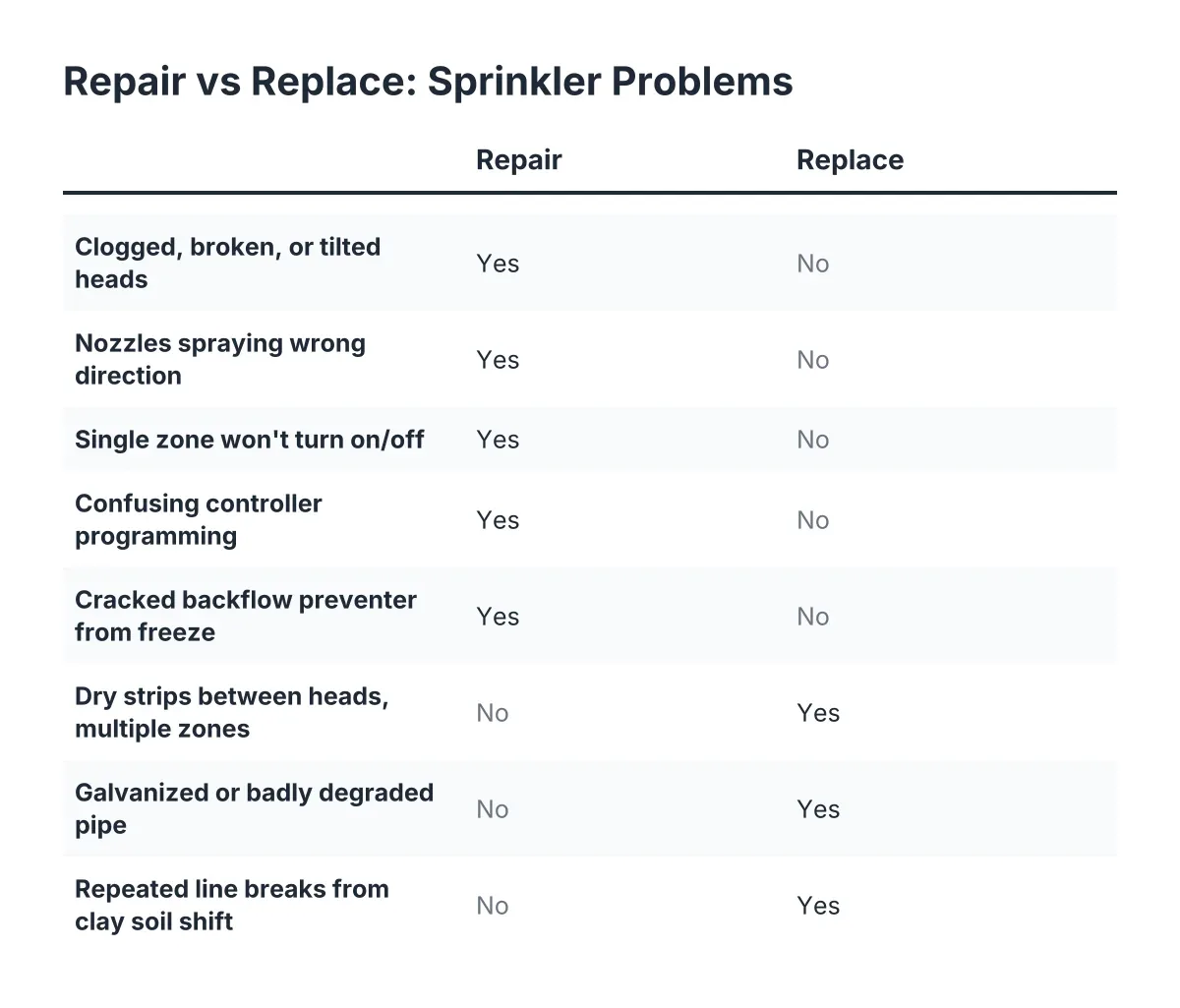
Most of what looks broken on an inherited system is fixable for far less than a new installation. The distinction that matters is whether the problem lives in the parts or in the design.
These issues are almost always repair-level work:
- Heads that are clogged, broken, tilted, or buried in the turf; sprinkler head replacement is routine work
- Nozzles spraying the wrong direction; this is one of the most common things found during a spring start-up and it is usually a fast sprinkler head adjustment
- A single zone that will not turn on or will not shut off, which often points to a sprinkler valve replacement
- A confusing controller, which is a programming problem, not a hardware problem, in most cases
- A cracked backflow preventer from a freeze, which is a repair, not a reason to replace the whole system
In contrast, these problems point toward new sprinkler system installation:
- Dry strips between heads across multiple zones, which means the heads were never spaced correctly in the first place
- Galvanized or badly degraded pipe that breaks every time someone touches it
- A system that no longer matches the landscape, for example flower beds and trees added long after the pipe went in
- Repeated line breaks from shifting clay soil, where each repair just moves the stress to the next weak joint
- Too few zones for the yard, so the water pressure cannot push every head properly no matter how you program it
The spacing issue deserves emphasis. Good coverage follows a head-to-head principle, meaning each head's spray should reach the neighboring head. If the original installer cut corners on spacing, you will chase brown patches forever. No sprinkler head adjustment fixes pipe that was laid three feet too far apart.
How to Determine If Repair or Replace Makes Sense for Your Plano System
A simple way to decide is to compare the cost of fixing what is broken against the cost of starting over, then factor in how well the original design fits your yard. If the pipe layout is sound and the problems live in heads, valves, and the controller, repair wins. If the layout itself is wrong, repair money disappears into a system that will never water evenly.
Run through these questions with your walk-through notes in hand:
- Do at least most zones run when commanded? If yes, the wiring and valves are mostly alive, which favors repair.
- Are the brown spots next to specific heads, or in bands between heads? Spots next to heads suggest misdirected or failing nozzles, a cheap fix. Bands between heads suggest a spacing problem baked into the design.
- How old is the system? A system from the last 10 to 15 years usually has parts still made and supported. Older systems may use heads and valves that are harder to match.
- Has the pipe broken more than once in the same area? Plano's heavy clay soil shifts as it dries and swells, and it cracks rigid lines. One break is bad luck. Repeated breaks in different spots signal brittle pipe throughout.
- Does the zone count fit the yard? A large corner lot running on four zones will struggle regardless of how good the heads are.
Here is a hypothetical to make it concrete. Suppose a buyer closes on a 2008 build near Legacy and finds half the backyard brown. A walk-through shows two heads spraying the fence, one zone that never fires, and a controller set to water three minutes per zone. In that scenario, nothing points to replacement. A sprinkler head adjustment, one valve repair, and a proper watering schedule would likely bring the lawn back. Replacement would be the wrong answer.
Now flip it. Suppose the same buyer finds dry stripes running through every zone, a repair history in the seller's disclosure showing four line breaks in three years, and pipe that crumbles when a technician digs up a head. In that scenario the system's bones are failing, and money spent on repairs is money spent twice.
What a Professional Inspection Adds That a Walk-Through Cannot
A professional sprinkler system inspection catches problems a homeowner cannot see from the surface, which is exactly what you need before deciding whether to repair or replace your system. A technician tests water pressure, checks each valve electrically, and confirms the backflow preventer actually protects your drinking water. The visible heads are the easy part; the verdict lives underground.
Diagnosing a dead zone, for example, is a process of elimination. The technician confirms water and power reach the valve, then isolates whether the fault sits at the controller, in the wiring, or in the valve itself. That is not something you can figure out by staring at a brown patch.
An inspection also includes a full walk of the property looking for hidden leaks. Previous owners sometimes tapped drip lines into existing zones and buried them, and those lines can leak for years without anyone noticing. A good tech also looks for signs of recent digging or cable installation, because utility crews sometimes nick irrigation pipe without the homeowner ever knowing.
The water math justifies the visit on its own. According to the U.S. Environmental Protection Agency (EPA WaterSense), a household with an automatic irrigation system that is not properly maintained can waste up to 25,000 gallons of water annually. For a new owner who just took over an unknown system, that waste shows up on the water bill before it shows up in the lawn.
Is it worth paying for an inspection instead of just watching for problems? Watching works for obvious failures, like a geyser at a broken head. It does not work for underground leaks, weak pressure, or a backflow preventer that fails silently. If you plan to keep the home and the lawn, one inspection in your first season answers questions that would otherwise take you two summers of trial and error to learn.
When New Installation Is the Right Call
New sprinkler system installation makes sense when the existing system's design, pipe condition, or zone layout cannot deliver even coverage no matter how many parts you replace. That is the honest threshold. Installation is the bigger upfront cost, so it has to earn its place by fixing problems repair cannot touch.
There are also cases where partial installation beats both extremes. A contractor can sometimes keep the sound zones and rebuild only the failed ones, or add a zone for a new flower bed without touching the rest. This middle path suits new owners who do not want to pay for everything at once, and it is worth asking about before anyone quotes a full tear-out.
A new or rebuilt system also opens the door to a smarter controller. According to the U.S. Environmental Protection Agency (EPA WaterSense), replacing a clock-based irrigation controller with a WaterSense labeled controller can cut an average home's irrigation water use by up to 30 percent, saving up to 15,000 gallons annually. In a city with summer watering restrictions and long dry stretches, a controller that adjusts to weather instead of running a fixed clock pays off quickly.
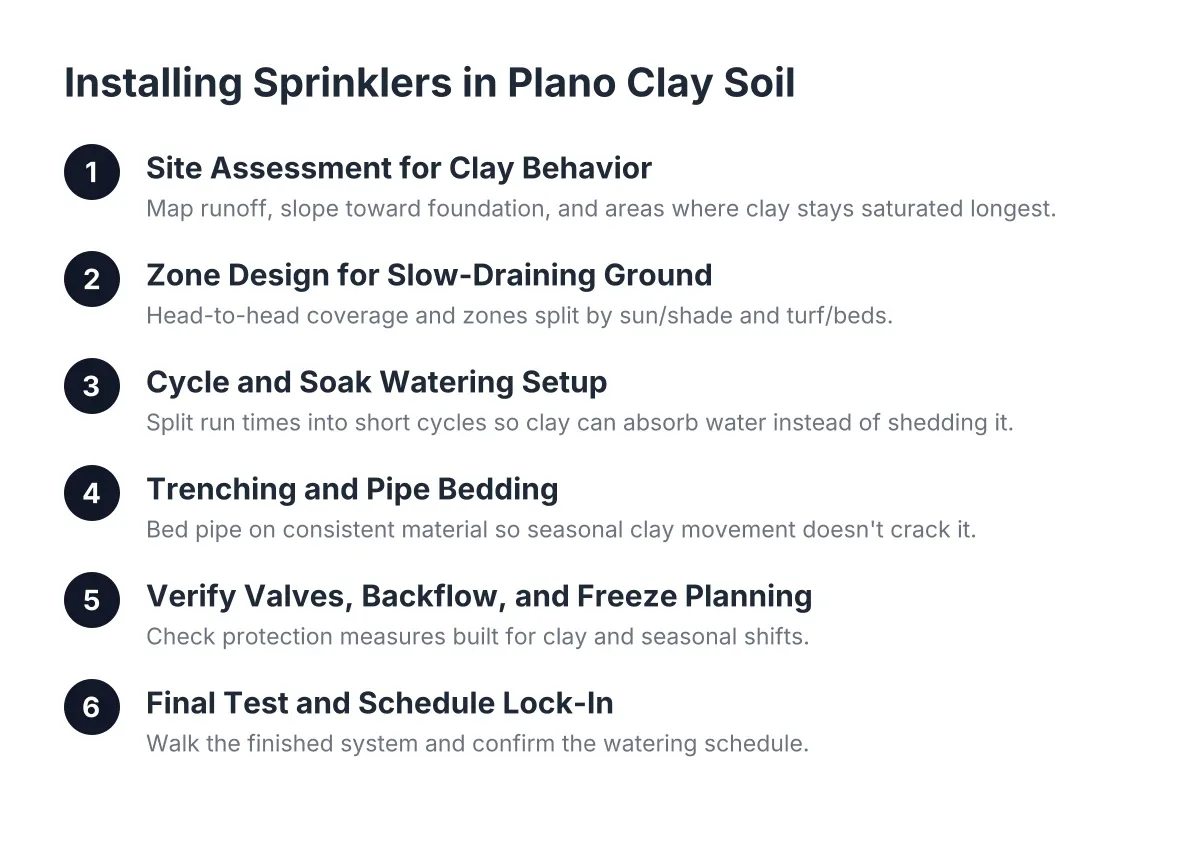
Design quality is where installation earns its money. Proper head-to-head spacing, zones separated by plant type and sun exposure, and pipe depth suited to Plano's shifting clay all get decided on day one. Those decisions are cheap to make during installation and expensive to correct afterward. If you want more detail on how clay soil shapes those choices, that topic deserves its own deep look.
One honest trade-off: a full installation tears up parts of the yard, and the lawn needs a few weeks to recover from trenching. If your system only needs heads, valves, and programming, repair gets you a green lawn faster and for less.
Signs That Help Determine If Your Plano Yard Is Telling You Something
The lawn itself is the best diagnostic tool you have, and reading it correctly saves you from paying for the wrong fix. Yellow or dry spots next to a head usually mean a misdirected or failing nozzle, not a system-wide problem. Dry bands between heads across the yard point to a spacing flaw from the original installation.
Watch for these patterns through your first full summer:
- Soggy ground or unusually green patches when the system has not run, which suggests an underground leak
- A water bill that jumps with no change in your watering schedule
- Heads that sputter or barely pop up on one zone, which can mean a pressure problem or a cracked line feeding that zone
- Runoff into the street before the cycle ends, which in Plano's clay usually means run times need splitting into shorter cycles, not that the system is broken
- Zones that run at odd hours you never programmed, which points to controller confusion rather than hardware failure
Context matters here too. As of 2026, Plano enforces seasonal watering restrictions that limit which days and times you can run the system. A lawn that looks stressed in August may be a scheduling problem, not an equipment problem. Set the watering schedule to match the allowed days before concluding anything is broken.
If the signs still point in both directions after a summer of watching, that is the moment to bring in a professional rather than guess. Pressure testing and valve diagnostics are not do-it-yourself territory, and misreading the signs can send repair money into a system that needs replacing, or replacement money into a system that needed a valve.
Making the Decision as a New Owner
Pull the pieces together in this order. First, do the one-hour walk-through and build your inventory. Second, separate the problems into repair-level and design-level using the lists above. Third, get a professional inspection if anything underground is in question, or if the repair list is long enough that you want a second opinion on whether the system deserves the investment.
Therefore, the decision usually resolves itself into one of three paths. Repair and tune the system you have, which is the right call for most inherited systems with sound layouts. Rebuild the failed portions while keeping what works, which suits owners pacing their spending. Or commit to new installation, which is the right call when the design itself is the problem.
Whichever path you take, get on a seasonal rhythm afterward. A spring start-up with a backflow check and a fall shutdown before the first freeze catches small problems while they are still small. EPA WaterSense notes that a well-managed irrigation system can cut irrigation water use by 15 percent, or nearly 7,600 gallons annually. For a new Plano owner, that rhythm turns a mystery system into one you understand, and it keeps the biggest decision, repair versus replace, from sneaking up on you again.
If you need sprinkler repair, North Dallas Sprinkler Repair can help.
Prefer to talk it through? Call (469) 639-1022 — a quick call is usually the fastest way to get a straight answer for your situation.