Why Your Sprinkler Stopped Working: A Plano Homeowner’s Diagnosis Guide
You just moved into a Plano home, the previous owner left zero notes, and half the yard looks brown. Before you search for sprinkler repair in Plano, TX, it helps to understand why systems stop working in the first place. Most sprinkler problems trace back to a short list of causes, and knowing which one you have tells you whether it is a five-minute adjustment or a job for a sprinkler system contractor.
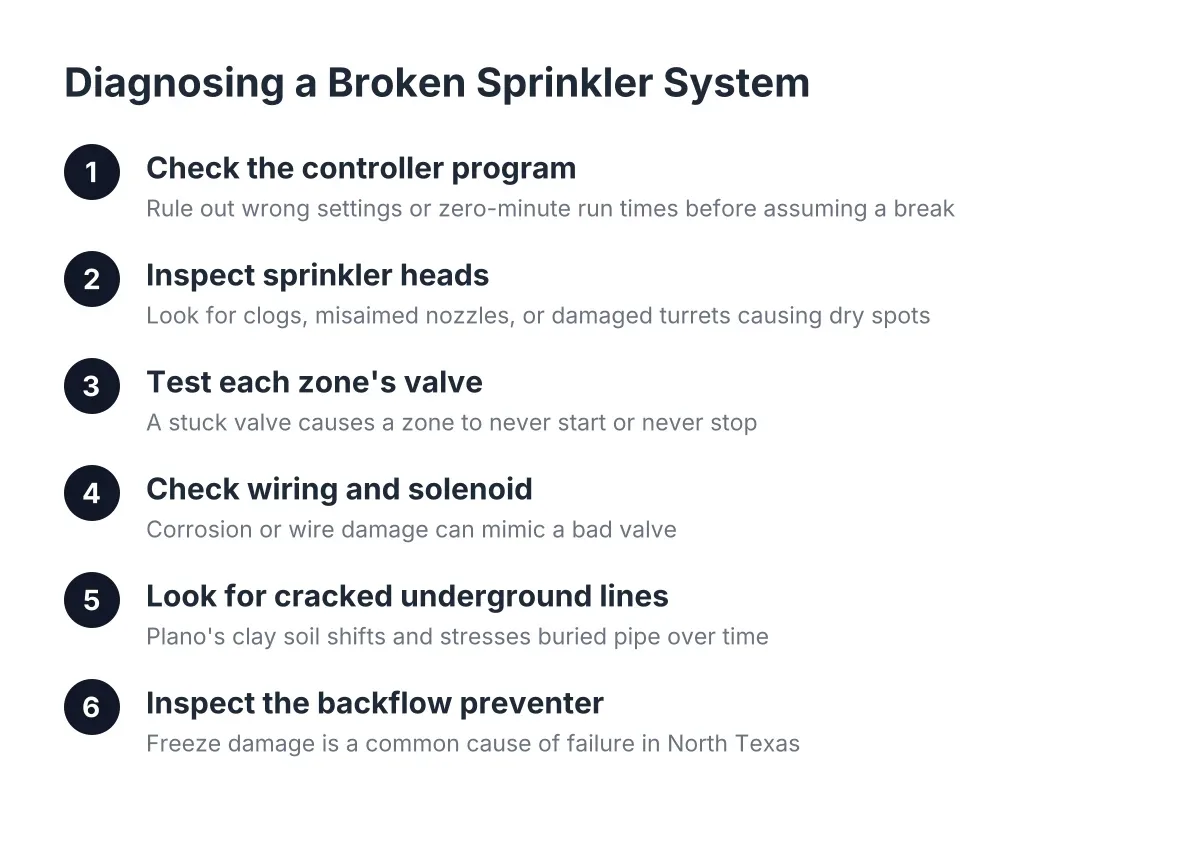
This guide walks through the seven most common reasons a sprinkler system stops working in North Texas, in the order a technician would check them. By the end, you will know what to look at, what you can safely handle yourself, and when the problem needs a pro.
1. The Controller Is Set Wrong, Not Broken
The most common "broken" sprinkler system is a controller running the wrong program. If you inherited a system with no manual, the previous owner's settings may not match your lawn, the season, or the Plano watering schedule. A zone that never runs might simply have a zero-minute run time programmed in.
Start by finding the make and model on the controller face, then pull up the manufacturer's manual online. Run each zone manually from the controller and walk the yard while it runs. Count your zones, note which part of the yard each one covers, and write it on a card taped inside the controller box. That one step solves the "how many zones does my sprinkler have" mystery for good.
However, if the display is blank, buttons do not respond, or zones run at random times, you may need sprinkler controller repair or a replacement. According to U.S. Environmental Protection Agency (EPA WaterSense), replacing a clock-based irrigation controller with a WaterSense labeled controller can cut an average home's irrigation water use by up to 30 percent and save up to 15,000 gallons annually. For a mystery system, a new controller is often the cheapest upgrade with the biggest payoff.
2. Sprinkler Heads Are Clogged, Broken, or Aimed Wrong
Yellow or dry spots in the lawn usually point to a misdirected or damaged sprinkler head, not a deep system fault. Heads get clipped by mowers, clogged with North Texas clay, or knocked out of alignment over time. Nozzles facing the wrong direction, spraying the fence instead of the grass, are one of the most common findings during a spring start-up, and the fix is usually quick.
A rotor head has a body buried in the ground, a riser that pops up, a turret that rotates, and a nozzle at the top that sprays the water, according to Hunter Industries. If the turret does not rotate or the spray pattern looks weak and uneven, the head needs cleaning, a sprinkler head adjustment, or a sprinkler head replacement. One useful detail from Toro: the radius adjustment screw on a rotor nozzle also holds the nozzle in place, so turning it affects both spray distance and whether the nozzle stays seated.
Brown grass at the far edge of a zone often means the rotor's spray radius is set too short. Lengthening the radius can fix the dry patch without replacing anything. This is the kind of call a tune-up visit answers in minutes.
3. A Valve Is Stuck, and the Zone Will Not Start or Will Not Stop
Each zone has a control valve that opens and closes on a signal from the controller. When a single zone refuses to run while the others work fine, the problem usually sits at that zone's valve or its wiring. When a zone keeps running water even after you shut the controller off, that points to a failed valve, not a controller problem.
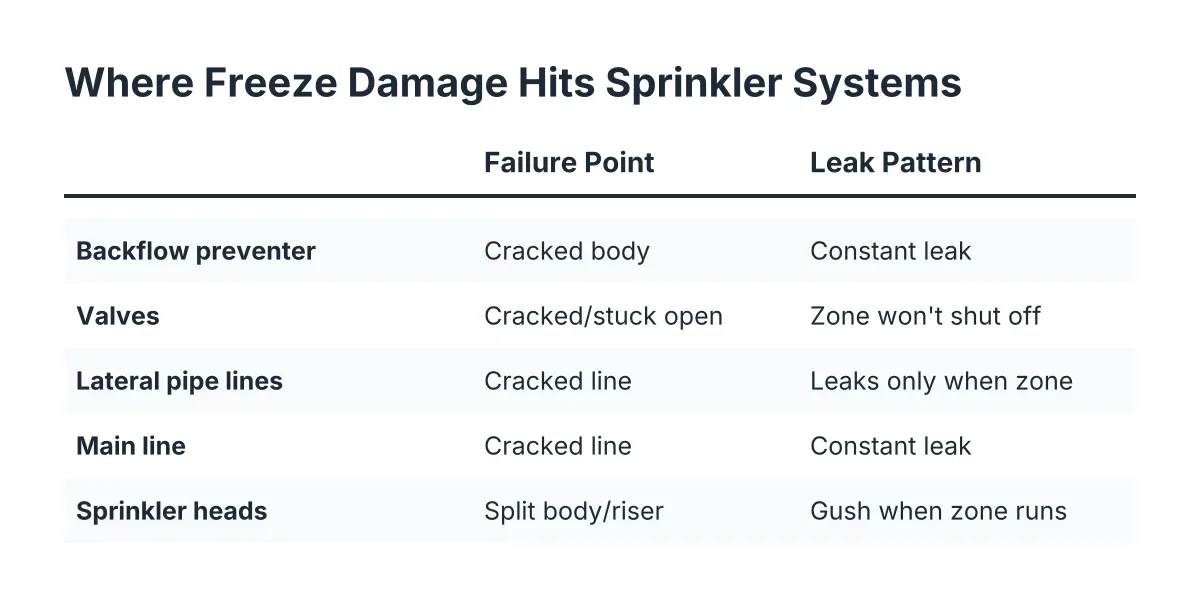
Irrigation control valve repair involves shutting off the water supply, opening the valve body, and replacing the diaphragm or solenoid, or swapping the whole valve. Plano's freeze events are hard on valves and backflow preventers; a hard freeze can crack valve bodies that were not drained before winter. If you bought the house after a winter like February 2021, a cracked valve from that freeze may still be hiding in a valve box.
If you need to stop a runaway zone right now, learn how to turn off a sprinkler system at the source. Look for a shutoff valve near the backflow preventer or the main line, usually close to where the system ties into the house supply. Shutting that valve stops the water until a sprinkler valve replacement can happen.
4. The Wiring or Solenoid Lost Its Connection
Every valve opens because a low-voltage wire carries a signal from the controller to a solenoid on the valve. Corroded splices, chewed wires, and shovel damage from landscaping projects all break that signal. The symptom looks identical to a bad valve: one zone dead while everything else runs.
A technician diagnosing a dead zone works in a set order. First, confirm the system has water and power by checking whether other zones run normally. Next, test whether the electrical signal reaches the solenoid. Then isolate whether the fault sits at the controller, somewhere along the wire, or in the solenoid itself. That sequence keeps you from replacing parts that were never broken.
In addition, anyone opening a valve box should cut power to the controller and shut off the water first. Skipping either step risks a face full of water or a shorted wire. This is a reasonable DIY job for a confident homeowner with a multimeter, and a routine one for an irrigation repair tech.
5. A Line Is Cracked Underground, Often Thanks to Plano's Clay Soil
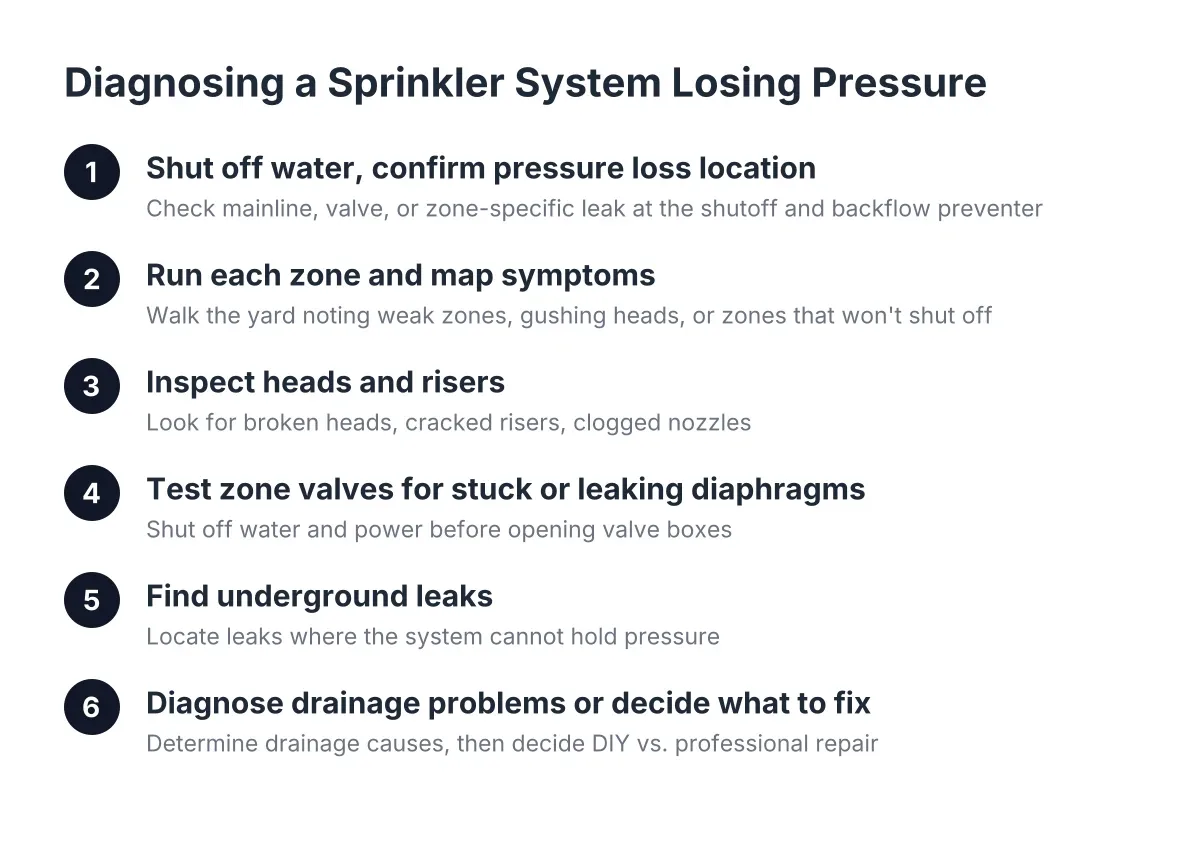
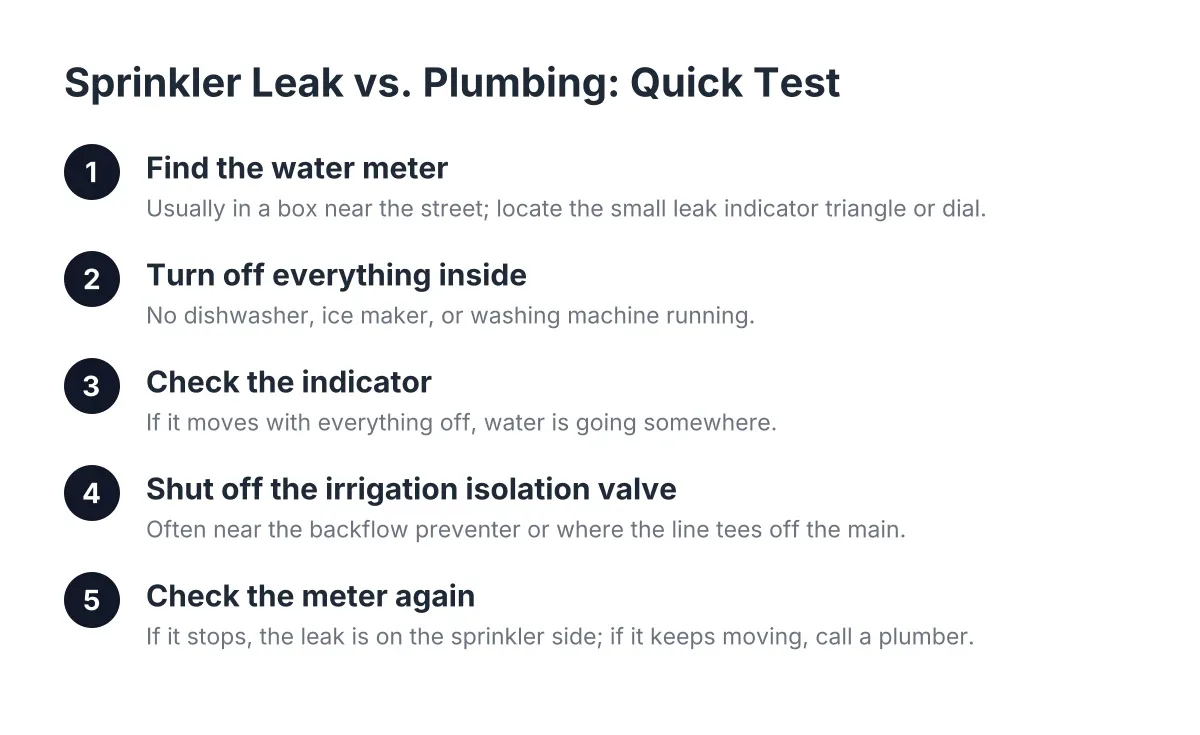
North Texas sits on heavy clay soil that swells when wet and shrinks hard in a dry summer. That movement stresses buried pipe, and over years it cracks lines and loosens fittings. Signs of a broken line include a soggy patch that never dries, water bubbling up when a zone runs, low pressure across several heads, or a water bill that jumped for no clear reason.
If you are wondering how to fix a broken sprinkler line, the repair itself is straightforward: dig to the break, cut out the damaged section, and splice in new pipe with couplings. Finding the break is the hard part, especially on an undocumented system where you do not know where the lines run. The stakes are real. A household with an automatic irrigation system that is not properly maintained can waste up to 25,000 gallons of water annually, according to U.S. Environmental Protection Agency (EPA WaterSense).
One more thing to check on an inherited system: previous owners sometimes tapped drip lines into an existing spray or rotor zone and buried them. Those lines can leak undetected for years. A full-property leak inspection catches them.
6. The Backflow Preventer Took Freeze Damage
The backflow preventer protects your drinking water from irrigation water flowing backward into the house supply. It sits above or near ground level, which makes it the most freeze-exposed part of the whole irrigation system. After a hard North Texas freeze, cracked backflow devices are one of the most common spring repair calls.
Watch for water spraying or seeping from the backflow assembly when the system runs, or a system that lost all pressure after a cold snap. Backflow work ties directly into the safety of your home's water supply, so this is one repair where hiring a professional makes sense rather than attempting a DIY fix. It is also why fall shutdown and spring start-up visits earn their keep; draining and protecting the backflow before the first freeze prevents the repair entirely.
7. The System Works Fine, but the Schedule Fights Plano's Rules and Weather
Sometimes nothing is broken. The system just runs on the wrong days, at the wrong times, or for the wrong duration. Plano enforces a lawn watering schedule with assigned days and seasonal restrictions, and a controller still running the previous owner's program may violate it or underwater the lawn in a 100-degree August.
Suppose a new-build owner in Plano closes in June, inherits a controller programmed for ten minutes per zone at noon, and watches the bermuda grass brown out by July. In that scenario nothing needs sprinkler repair at all; the fix is reprogramming for early-morning run times on the correct days, with longer cycles for sun-baked zones. According to U.S. Environmental Protection Agency (EPA WaterSense), a well-managed irrigation system can cut irrigation water use by 15 percent, or nearly 7,600 gallons annually. Good scheduling is maintenance, not a luxury.
What a Sprinkler Repair Visit in Plano, TX Usually Includes
A standard sprinkler repair visit in Plano, TX starts with a full system check: running every zone, inspecting each head, testing the controller, and checking valves and the backflow preventer for leaks or freeze damage. The technician then explains what is broken, what is just set wrong, and what each fix involves before any work starts.
Typical scope on a repair or tune-up visit includes:
- Running and mapping every zone, which is the inspection a mystery-system owner needs most
- Sprinkler head adjustment, cleaning, and sprinkler head replacement where heads are damaged
- Valve and solenoid testing, with sprinkler valve replacement if a valve has failed
- Controller programming matched to the current Plano watering schedule
- A leak check across the property, including buried drip lines
Jobs that usually cost extra include locating and repairing broken underground lines, replacing a controller, rebuilding a freeze-damaged backflow assembly, and larger projects like sprinkler system installation or French drain installation for drainage problems the sprinkler cannot solve. Cost depends on parts needed, how many heads or valves are involved, and how much digging the repair requires. Most single-issue repairs finish in one visit; hunting a buried leak on an unmapped system can take longer.
Choosing a Sprinkler Repair Company in Plano, TX
Picking a provider for sprinkler repair in Plano, TX comes down to three questions. Ask whether they diagnose the whole system or only patch the symptom you called about. Ask whether they explain the cause and the cost factors before starting work. And ask whether they offer seasonal start-up and shutdown visits, since a standing twice-a-year relationship catches freeze damage and schedule drift before they turn into dead lawn.
A fair quote names the specific parts and labor involved, separates must-fix items from nice-to-have upgrades, and never pressures you to fix everything at once. For a new owner inheriting an unknown system, that first full inspection does double duty: it fixes what is broken and finally documents what you own.
If you just bought a home in Plano and the irrigation system is a question mark, North Dallas Sprinkler Repair can walk every zone with you, map the system, and give you a plain-English rundown of what works, what is broken, and what each repair involves. Reach out to schedule an inspection or a seasonal tune-up before the next freeze or the next brown patch decides for you.
If you need sprinkler repair, North Dallas Sprinkler Repair can help.
Prefer to talk it through? Call (469) 639-1022 — a quick call is usually the fastest way to get a straight answer for your situation.