DIY Sprinkler Head Repair vs. Calling a Pro: A Step-by-Step Guide for Plano Homeowners
A broken sprinkler head rarely announces itself. More often, you notice water pooling in the same spot every time the system runs, a geyser near the sidewalk, or a soggy patch by the flower beds that never dries out. The good news is that DIY sprinkler head repair is one of the most approachable fixes a homeowner can take on, though knowing when to call a professional for sprinkler repair vs pro versus attempting it yourself is key. The catch is knowing which symptoms you can handle with a screwdriver and a shovel, and which ones point to a deeper problem under your Plano lawn.
This guide walks you through the repair step by step. Along the way, it flags the exact moments where a do-it-yourself fix stops making sense and a sprinkler system contractor earns their fee. If standing water near your foundation is what sent you here, pay close attention to Step 6; sometimes the head is fine and the real issue is drainage.
Why does this matter beyond a muddy spot? According to the U.S. Environmental Protection Agency (EPA WaterSense), a household with an automatic landscape irrigation system that is not properly maintained can waste up to 25,000 gallons of water annually. In a North Texas summer with watering restrictions in play, that waste shows up on your bill and in your yard.
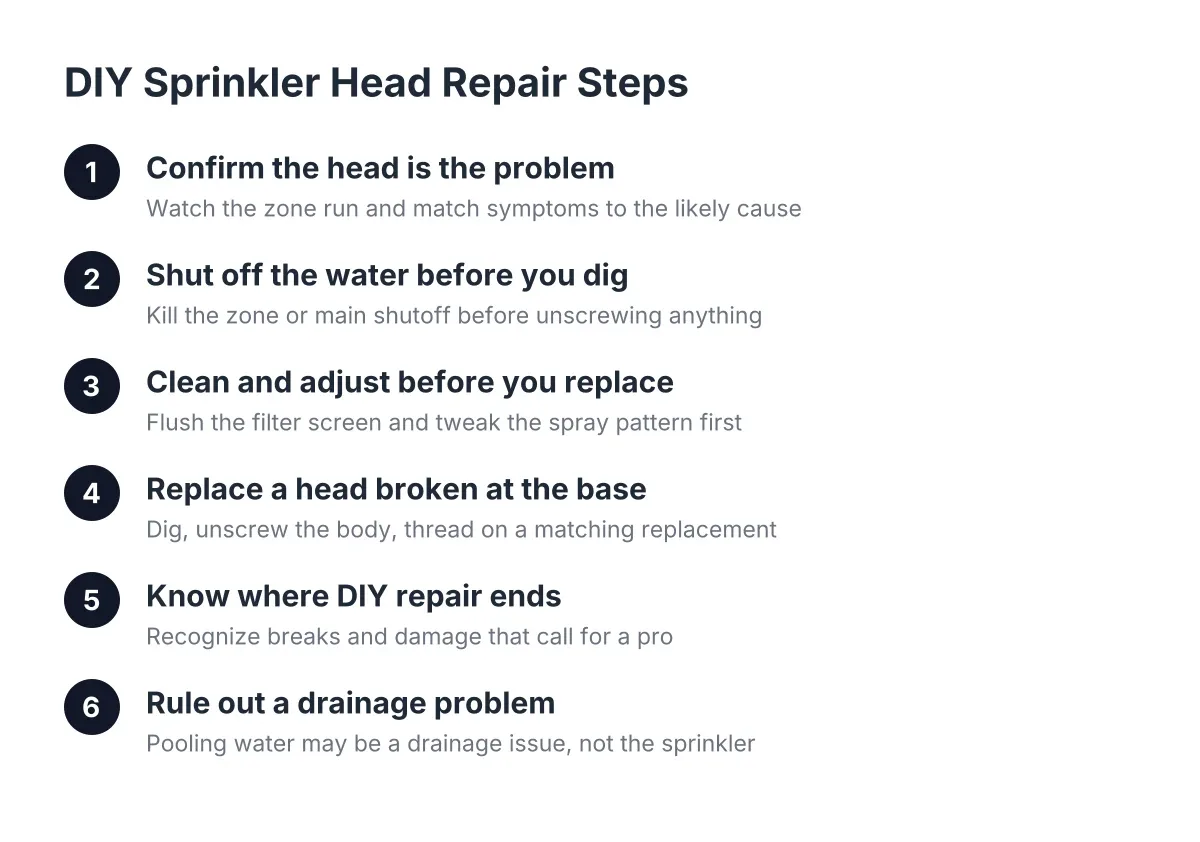
Step 1: Confirm the Head Is Actually the Problem
Before you buy parts, watch the system run. Turn on the zone with the suspect head and look closely. Different symptoms point to different fixes:
- Water bubbles up but the head never rises: the head may be stuck down, clogged, or broken below grade.
- The head pops up but sprays weakly or unevenly: the filter screen inside is likely clogged with dirt or clay sediment.
- Water shoots straight up like a fountain: the nozzle or the whole top of the head has snapped off, often from a mower strike.
- The head sprays fine but water pools nearby anyway: the head may be fine; suspect a leaking line, a low spot, or a drainage problem.
- Several heads in one zone are weak or stuck: that points to a valve or pressure problem, not a single head.
Here is a quick anatomy lesson that makes everything else easier. According to Hunter Industries, a rotor sprinkler has a body buried in the ground, a riser that rises from it, a turret that moves during operation, and a nozzle at the top that sprays the water. When the body is intact and only the top parts are damaged, repair is simple. When the body itself is cracked or the pipe below it is broken, the job gets bigger.
One common issue deserves a mention because it fools a lot of homeowners. A nozzle facing the wrong direction, soaking the driveway while the grass stays dry, looks like a broken head. It is usually a quick sprinkler head adjustment, not a replacement.
Step 2: Shut Off the Water Before You Dig
Never dig around a pressurized head. Shut the zone off at the controller, and if you plan to unscrew anything below the head, know how to turn off a sprinkler system at the main shutoff or the backflow preventer. Opening a fitting on a live line will spray you and flood the hole you just dug.
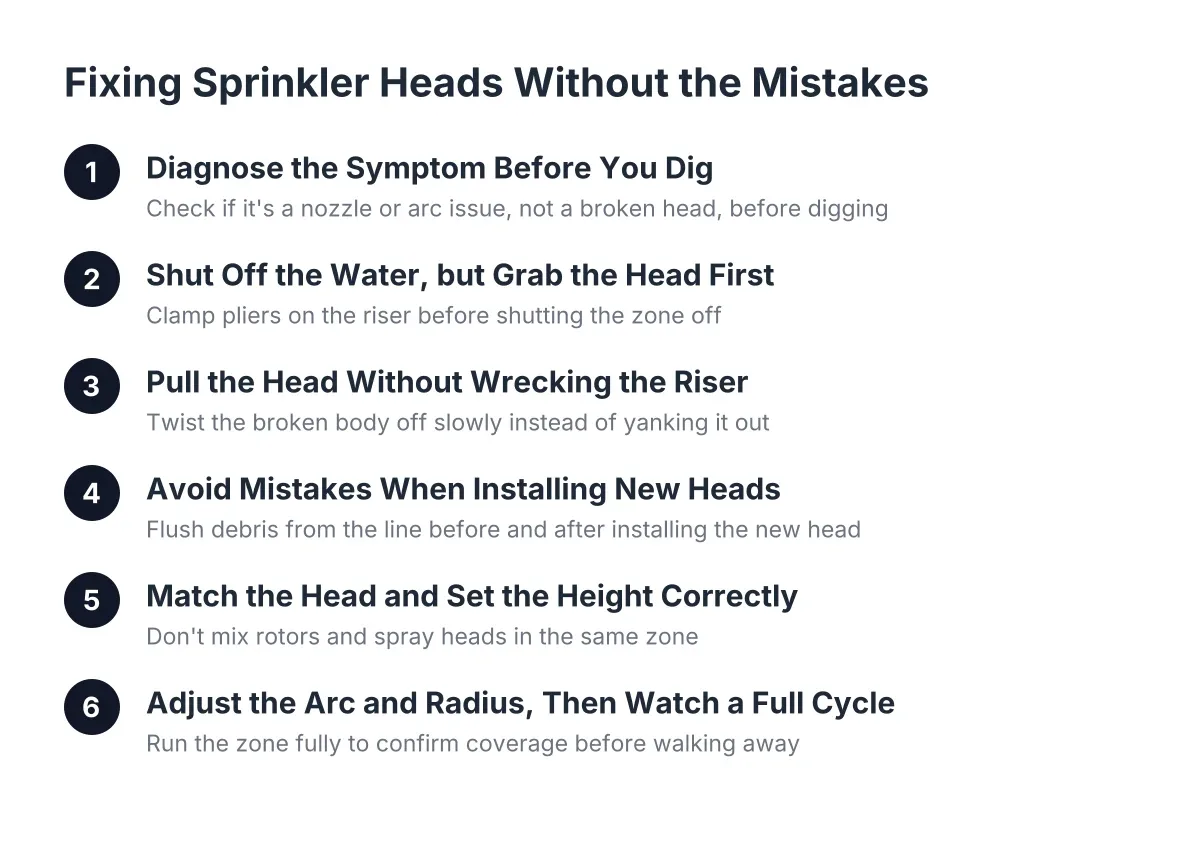
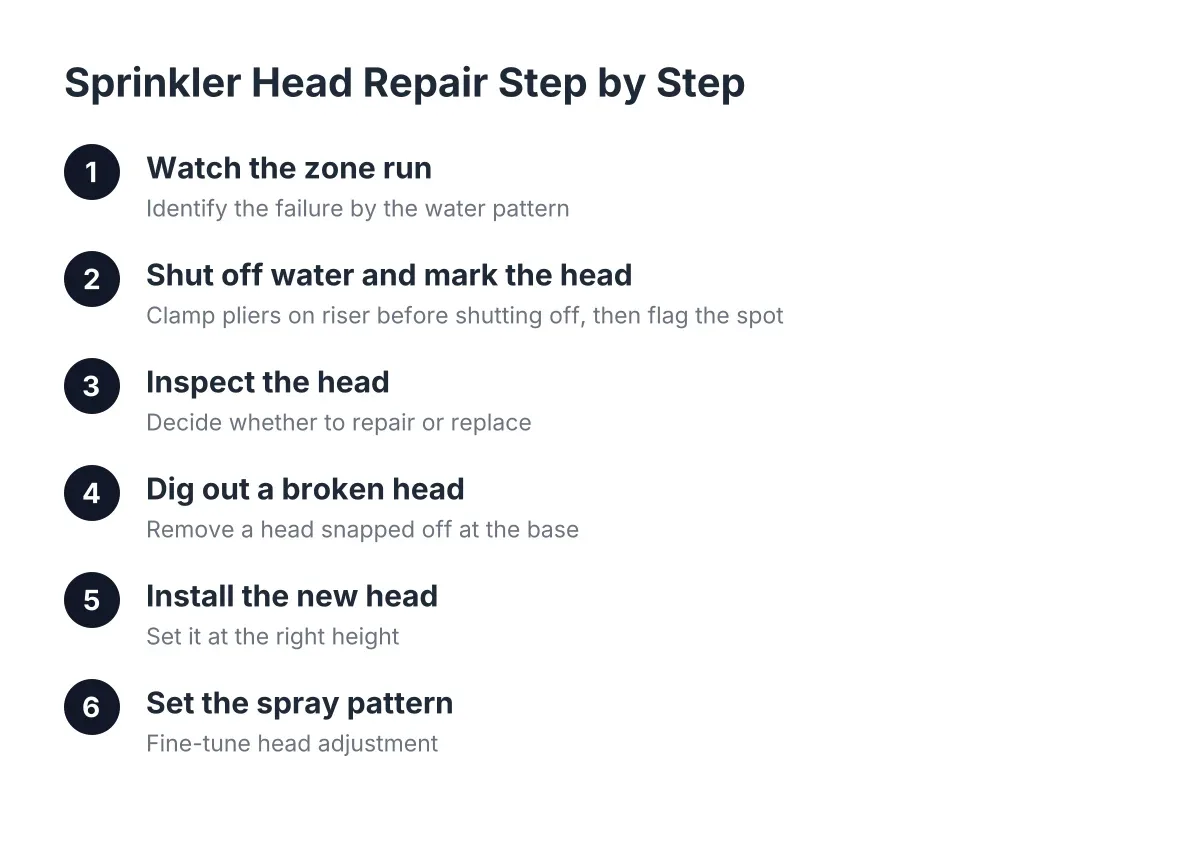
One practical trick: when a zone shuts off, pop-up heads retract into the ground, which makes them hard to grab. Before you kill the water, lightly clamp pliers around the riser so the head stays up. That saves you from digging blind for a head that dropped back below the grass line.
Step 3: Clean and Adjust Before You Replace
Many "broken" heads in Plano are just dirty. Our heavy clay soil shifts, cracks, and sheds fine sediment that works its way into spray heads. Unscrew the cap, pull out the riser and nozzle, and check the small filter screen inside. Flush it with water or scrape it clean, then reassemble and test. When sprinkler repair pros evaluate a system, they often start here, checking whether cleaning alone restores function.
While you have the head apart, check the spray pattern. On rotor nozzles, the radius adjustment screw does double duty; according to Toro, it also holds the nozzle in place. Turn it in small increments and retest. In addition, rotor pull-up slots are a universal design, so any brand's rotor adjustment tool can pull up the turret; you do not need the matching manufacturer's tool, according to Rain Bird.
If cleaning and adjusting restore a normal spray, you are done. This is the sweet spot for fixing sprinkler heads yourself: ten minutes, no digging, no parts.
Step 4: Replace a Head That Broke Off at the Base
A sprinkler head broke off at the base is the classic mower casualty, and it is still a fair DIY sprinkler head replacement if the break is clean. Here is the sequence:
- Dig a neat circle about six inches around the head, saving the sod to put back later.
- Unscrew the broken body from the fitting below. Most heads connect to the main line through flexible half-inch poly tubing on a threaded elbow, which also lets you raise or lower the new head to the right height.
- Clear dirt away from the open fitting so nothing falls into the line.
- Thread on a matching replacement body. Match the type (spray or rotor), the pop-up height, and the thread size.
- If the old body cracked but the internals survived, you can sometimes unscrew the nozzle and riser assembly and reuse them in the new body.
- Flush the line briefly before installing the nozzle, then set the head flush with the soil and test the spray pattern.
Set the new head so its spray reaches the neighboring heads. Irrigation systems are designed around head-to-head coverage, and a head set too low or aimed short leaves dry arcs in the lawn.
One caution from the field: if a head body is loose in the ground, forcing the arc adjustment can rotate the whole body instead of the internal stop. Pack soil firmly around the body before you fine-tune the arc.
Step 5: Know Where DIY Sprinkler Repair Ends
A single damaged head with a clean threaded connection is a homeowner job. For complex jobs, sprinkler repair pros handle the following situations more reliably than a DIYer usually can:
- The pipe or fitting below the head is cracked. North Texas clay expands and contracts with moisture, and that movement snaps rigid fittings. Repairing buried pipe means cutting, gluing, and pressure-testing, and a bad joint leaks invisibly underground.
- Every head in a zone is stuck down or weak. A sprinkler head stuck down across a whole zone points to a failing valve or low pressure, and sprinkler valve replacement involves wiring and the manifold. Shut off power to the controller and the water supply before anyone touches a solenoid.
- You find leaks you cannot trace. Previous owners sometimes tapped buried drip lines into a spray zone, and those lines can leak undetected for years. Finding them takes systematic zone-by-zone diagnosis.
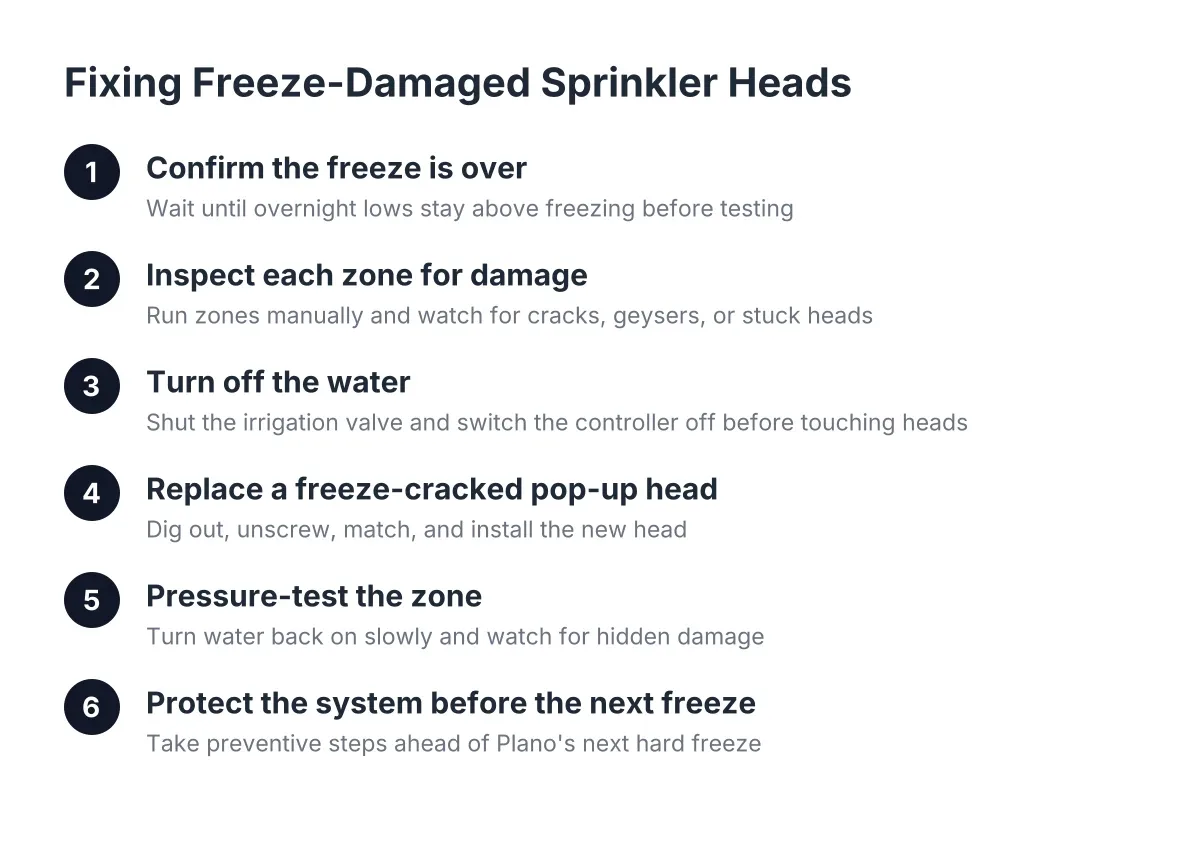
- The backflow preventer is damaged. Plano freeze events crack backflow assemblies, and that repair protects your drinking water. It belongs with a professional.
- Water pools in the same spot even after the head is fixed. Keep reading.
There is a water argument for keeping the whole system tuned, too. The EPA WaterSense program reports that a well-managed irrigation system can reduce a household's irrigation water use by 15 percent, or nearly 7,600 gallons annually. A tuned system is not just a repaired system.
Step 6: Rule Out a Drainage Problem Masquerading as a Sprinkler Problem
Suppose a homeowner near Legacy and Coit fixes a leaning spray head, tests the zone, and the spray looks perfect. Two days later, the same low spot by the foundation holds water again after every cycle. In that scenario, the sprinkler was never the whole story. The yard either slopes toward the house or the clay soil cannot absorb the runtime.
Run this simple test. Water the zone for its normal cycle, then check the spot at one hour and at twelve hours:
- Gone within an hour or two: likely a runtime or watering schedule issue. Shorter, repeated cycles let clay soil absorb water instead of shedding it.
- Still standing after twelve hours with no leak found: that is a grading or drainage problem. A French drain installation along the wet line may be the fix that actually ends it.
- Wet even on days the system does not run: suspect a leaking line or valve, which needs irrigation repair before anything else.
This distinction matters for your foundation. Repeated saturation against a slab in expansive clay causes the soil movement that cracks foundations in the first place. Fixing a sprinkler head stops the water source; fixing drainage stops the water from sitting there.
When the Scale Tips Toward a Professional
Sprinkler head repair as a DIY job makes sense when the damage is one head, the connection is clean, and the fix tests out on the first try. Call a pro when the problem repeats, spreads across a zone, involves buried pipe, electrical components, or the backflow, or when standing water keeps returning after the head is fixed.
Cost-wise, think in factors rather than fixed numbers: how many heads are affected, whether the pipe below is intact, how deep the repair sits in that stubborn clay, and whether a valve or backflow is involved. A straightforward head swap sits at the low end; a zone-wide valve issue or a drainage fix sits higher.
One honest trade-off: a professional visit costs more than a replacement head from the hardware store, and for a single clean break the DIY route is the sensible one. The value of a pro shows up in diagnosis, catching the cracked lateral line, the mis-wired valve, or the drainage pattern a homeowner cannot see from the surface.
For Plano homeowners, the smartest version of DIY sprinkler repair versus professional help is a hybrid approach. Handle the cleanings, adjustments, and simple head swaps yourself. Then pair that with a seasonal check in spring and before the first freeze, when backflow and valve damage tends to happen here. You keep the easy wins, and the problems that hide underground get caught before they turn into a muddy yard or a foundation worry.
If you need sprinkler head repair, North Dallas Sprinkler Repair can help.
Prefer to talk it through? Call (469) 639-1022 — a quick call is usually the fastest way to get a straight answer for your situation.