How North Texas Clay Soil Complicates Sprinkler Installation (and How to Get It Right)
If you have ever pushed a shovel into a Plano yard in August, you know the problem already. North Texas clay soil turns hard as concrete in summer, swells like a sponge after rain, and shifts enough through the seasons to crack pipes and heave sprinkler heads out of line. That movement is the single biggest reason a new sprinkler installation in clay soil in this area either works for decades or starts failing in year two. This guide walks you through installing a system that is built for our clay, step by step, so you know what a good job looks like whether you dig it yourself or hire a sprinkler system contractor.
A quick note on scale before you start. According to the U.S. Environmental Protection Agency (EPA WaterSense), landscape irrigation accounts for nearly one-third of all residential water use nationwide, totaling nearly 9 billion gallons per day. A system designed for the wrong soil wastes a meaningful share of that, so the clay-specific choices below matter for your water bill, not just your lawn.
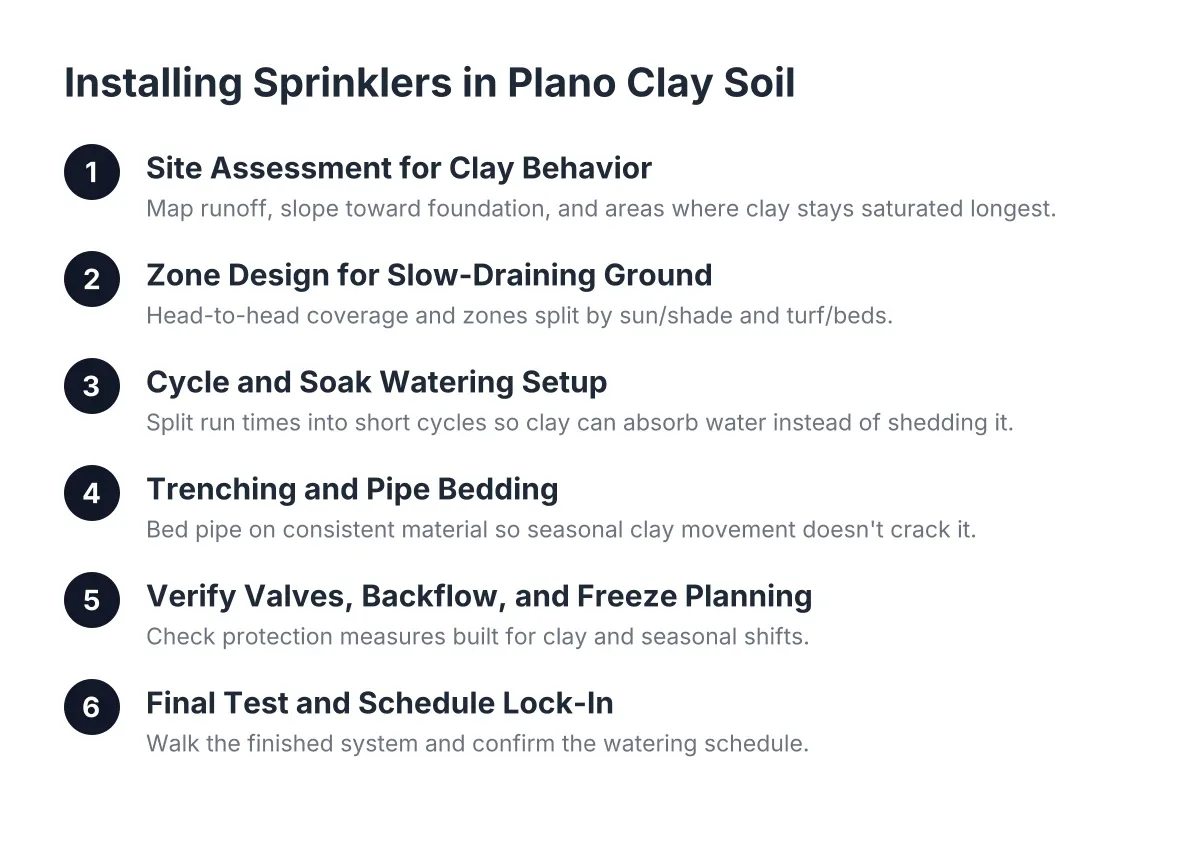
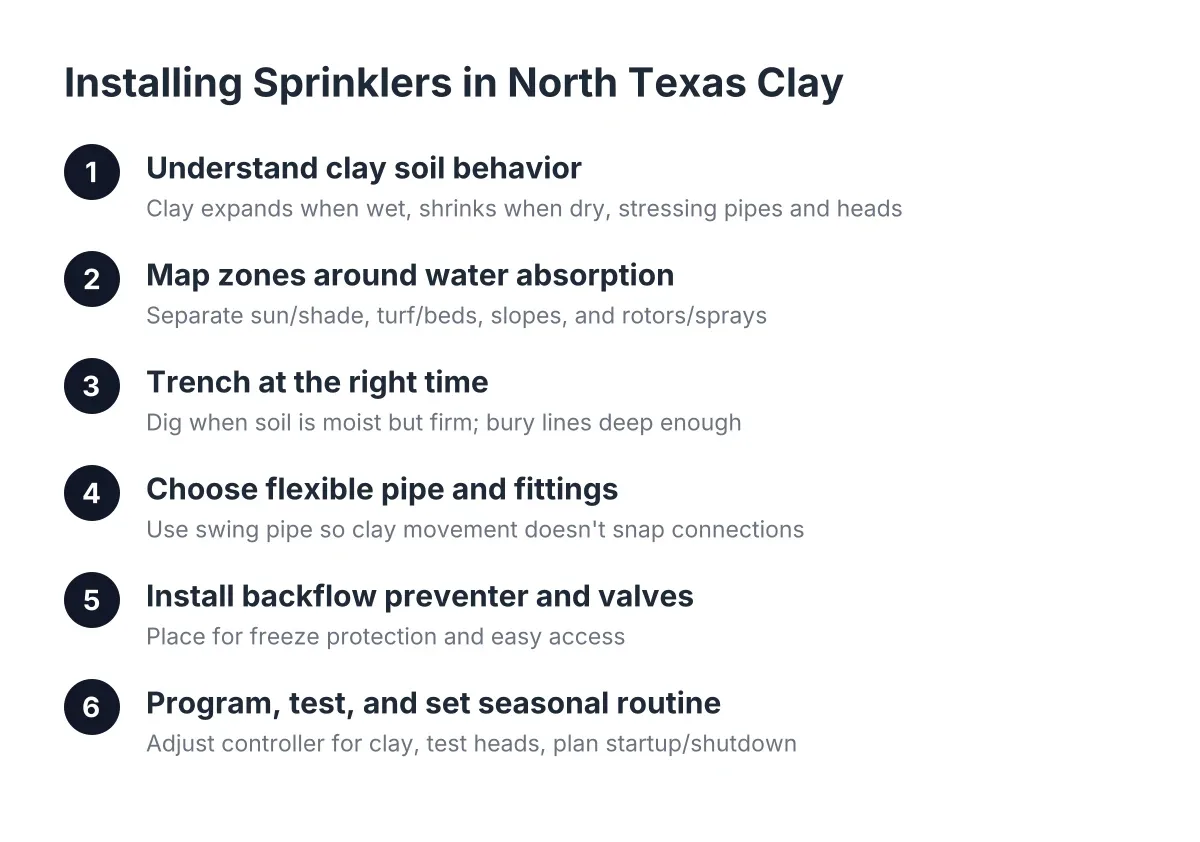
Step 1: Understand What North Texas Clay Soil Does to Irrigation Lines
Start by learning the enemy. The clay under most Plano yards, often called blackland or gumbo clay, expands when wet and shrinks when dry. Through a typical year of hot summers and sudden storms, the ground can move enough to stress rigid PVC pipe, twist fittings, and push buried heads up or pull them down.
Clay also absorbs water slowly. Spray water on it faster than it can soak in, and the excess runs off into the street or pools in low spots. That slow intake rate drives two of the biggest design decisions later in this guide: head spacing and run-time scheduling.
In addition, north texas clay soil tends to run alkaline, with a pH high enough to stress acid-loving plants. That does not change how you install pipe, but it should shape your plant and grass choices, which in turn shape your zone layout. Bermuda and zoysia handle clay and heat well, and they are the most common choices for new lawns here.
Step 2: Map Your Zones Around How Clay Absorbs Water
Next, design zones for slow soak-in, not for convenience. On sandy soil you can run a zone for 20 minutes and the water disappears. On clay, the same 20 minutes sends half the water down the gutter. Your zone map needs to account for that.
Keep these rules in mind when you sketch the layout:
- Separate sun from shade. A shaded bed on clay stays wet far longer than a sunny strip along the driveway.
- Separate turf from beds. Grass and shrubs need different amounts of water and different head types.
- Separate slopes from flat ground. Runoff starts fast on clay, and sloped zones need shorter, repeated cycles.
- Keep rotors and spray heads on different zones. They put out water at different rates, and mixing them makes even watering impossible.
For context on head types: a rotor sprinkler is built from a buried body, a riser that pops up, a rotating turret, and a nozzle at the top that sprays the water, according to Hunter Industries. Rotors cover large turf areas with a slower application rate, which suits clay. Fixed spray heads put water down fast, so they belong on small zones with short run times.
Step 3: Trenching for Sprinkler Installation in Clay Soil
Now dig, and dig at the right time. Trenching North Texas clay in a dry July is brutal and tears up the lawn; trenching after a soaking rain leaves you working in sticky muck. The practical window is when the soil is moist but firm, which usually means spring or fall. That timing is one reason installation calendars in Plano fill up before the season turns.
Trench depth matters more here than in forgiving soils. Lateral lines should sit deep enough that seasonal shrink and swell does not grind against them, and main lines deeper still. Shallow pipe laid in clay is the pipe that cracks when the ground splits open during an August drought.
Before any digging, call 811 to have utilities marked. In addition, walk the yard and note any signs of past digging or cable work. Buried lines from old projects show up in Plano yards more often than homeowners expect, and hitting one turns a one-day trench job into a repair project.
Step 4: Choose Pipe and Fittings That Tolerate Shifting Clay Soil
Clay movement is a slow-motion force, so build in flexibility. Use swing pipe, the short flexible connector between the rigid lateral line and each sprinkler head. When the clay heaves or settles, the swing pipe absorbs the movement instead of snapping the fitting at the head. Hard-piped heads on rigid risers are the first casualties in a shifting yard, which is why selecting proper materials for sprinkler installation in clay soil is critical.
Bed the pipe carefully. Clay clods the size of bricks dropped straight onto PVC create pressure points that crack lines later. Backfill in layers and compact lightly so the trench does not sink into a visible stripe across the lawn by October.
Set head height deliberately. Each head should sit flush with the mower's cutting path, with enough compacted soil under it to stay there. A head set too high gets scalped by the mower; one set too low gets buried as the clay swells around it. Also keep dirt and rocks out of open pipe during assembly. Debris that washes into risers and nozzles is one of the most common reasons a brand-new zone sprays poorly on day one.
Step 5: Install the Backflow Preventer and Valves for Freeze Protection
This step is where last winter's pipe-burst memory comes in. The backflow preventer keeps irrigation water from siphoning into your drinking water, and in North Texas it is also the component most likely to crack in a hard freeze. Install it where it can be insulated, drained, or shut off fast when the first freeze warning hits.
Place valve boxes where you can reach them, not where they look tidiest. When a sprinkler valve replacement becomes necessary years from now, an accessible box turns a two-hour job into a 30-minute one. Label the wires at the controller while everything is fresh; the homeowner troubleshooting a dead zone in 2030 will thank you.
Know how to turn off a sprinkler system before you need to. Locate the irrigation shutoff valve, usually near the meter or the backflow preventer, and test it during installation. When a freeze warning comes through Plano in December, you want a 60-second shutdown, not a flashlight search in the dark.
Step 6: Program the Controller for Clay, Not for the Factory Default
Here is where most new systems in Plano go wrong. The factory default on a controller might run each zone 15 to 20 minutes straight. On clay, water starts running off after 5 to 10 minutes. The fix is the cycle-and-soak method: run each zone in two or three short cycles with 30 to 60 minutes between them, so the water soaks in instead of sheeting into the street.
Suppose a homeowner in west Plano sets a new system to one 18-minute cycle per zone. In that scenario, the first 8 minutes soak in and the last 10 run down the curb. Splitting the same 18 minutes into three 6-minute cycles an hour apart puts nearly all of it into the root zone, with the same total run time.
Also set the watering schedule around local rules. Plano enforces watering restriction schedules, typically limiting which days you can run the system, and those rules tighten in drought years. Build your program around your allowed days from the start.
Controller choice pays off here too. According to the U.S. Environmental Protection Agency (EPA WaterSense), replacing a clock-based controller with a WaterSense labeled smart controller can cut an average home's irrigation water use by up to 30 percent, saving up to 15,000 gallons a year. On clay, where overwatering shows up as runoff and fungus rather than a greener lawn, that adjustment matters even more.
Step 7: Test Every Head and Fix Coverage Before You Backfill Fully
Before the trenches close, run every zone and walk it. Check three things at each head: direction, radius, and height. A nozzle facing the fence instead of the grass is one of the most common issues found at startup, and it takes seconds to fix now. Brown patches at the far edge of a zone later usually mean a rotor's radius is set too short; turning the radius screw counterclockwise extends the throw.
Watch for head-to-head coverage, meaning each head's spray reaches the neighboring head. Gaps in coverage on clay show up as hard, cracked dry spots by July, and fixing spacing after the lawn is established costs far more than fixing it now. This is also the stage where a professional eye earns its keep; pressure loss, head spacing math, and zone balancing are easy to get subtly wrong, and the symptoms do not appear until summer.
Step 8: Set Up a Seasonal Startup and Shutdown Routine
Finally, protect the investment. A system installed correctly for north texas clay soil still needs two touchpoints a year: a fall shutdown before the first freeze, and a spring startup once hard freezes have passed, usually by mid-March in Plano.
The fall visit shuts off and drains the backflow preventer and insulates exposed components. The spring visit repressurizes the system slowly, checks every valve and head, and resets the watering schedule for the season. According to the U.S. Environmental Protection Agency (EPA WaterSense), a household with an automatic irrigation system that is not properly maintained can waste up to 25,000 gallons of water annually, so these visits pay for themselves in water alone.
A handy homeowner can handle parts of this routine. However, if your system lacks drain points, your backflow preventer sits above ground and exposed, or you are unsure whether the lines are fully drained, bring in a professional before the first freeze rather than after. Freeze damage to a backflow preventer or valve manifold is one of the more expensive repairs in this trade, and it is almost entirely preventable.
What Sprinkler Installation in Clay Soil Costs Come Down To
Pricing a sprinkler system installation in Plano depends on factors, not a flat number: yard size, number of zones, trenching difficulty in hard clay, head and controller selection, and whether drainage work like French drain installation makes sense at the same time. Clay adds labor at the trenching stage and favors slightly better components, such as swing pipe at every head and a smart controller, so the cheapest bid is often the one designed for soil we do not have.
The payoff for doing it right is a system that survives the shrink-swell cycle, waters within Plano's restriction schedule, and does not greet you each spring with cracked fittings. Get the clay-specific details right at installation, and the next ten years of sprinkler repair calls become sprinkler tune-up calls instead.
If you need sprinkler system installation, North Dallas Sprinkler Repair can help.
Prefer to talk it through? Call (469) 639-1022 — a quick call is usually the fastest way to get a straight answer for your situation.