French Drain vs. Other Drainage Solutions: What Works for Plano Yards
If you just bought a home in Plano and found standing water in the yard, you are probably weighing a French drain against other drainage options. When evaluating drainage options and comparison of different systems, maybe the previous owner left you a sprinkler system with no manual, a soggy side yard, and no clue what was installed where. This guide compares the main ways to move water off a North Texas lot, so you can tell which fix matches your problem before you pay for anything.
Plano sits on heavy clay soil. Clay holds water near the surface instead of letting it soak in. That is why a yard here can stay wet for days after a storm while a sandy-soil yard dries overnight. The right drainage fix depends on where the water comes from, where it pools, and where you can legally send it.
Why Plano Clay Makes Drainage Decisions Different
Clay soil changes the math on every drainage option. Water moves through clay slowly, so solutions that depend on absorption, like dry wells, often underperform here. Solutions that physically carry water away, like a French drain or a surface channel, tend to work better.
Clay also shifts. It swells when wet and shrinks when dry, which cracks irrigation lines and can heave shallow pipes out of grade. Any buried drainage system in Plano needs enough slope and depth to keep working as the soil moves. Keep that in mind as you compare the options below.
One more local wrinkle: a wet spot is not always a drainage problem. Sometimes a buried sprinkler line or valve is leaking. If you inherited a mystery irrigation system from the previous owner, rule that out first. More on that at the end.
Comparing Drainage Options: French Drain vs. Other Choices
A French drain is a gravel-filled trench with a perforated pipe at the bottom. Water seeps into the gravel, enters the pipe through the perforations, and flows downhill to an exit point. It handles water that sits in the soil, not just water running across the surface.
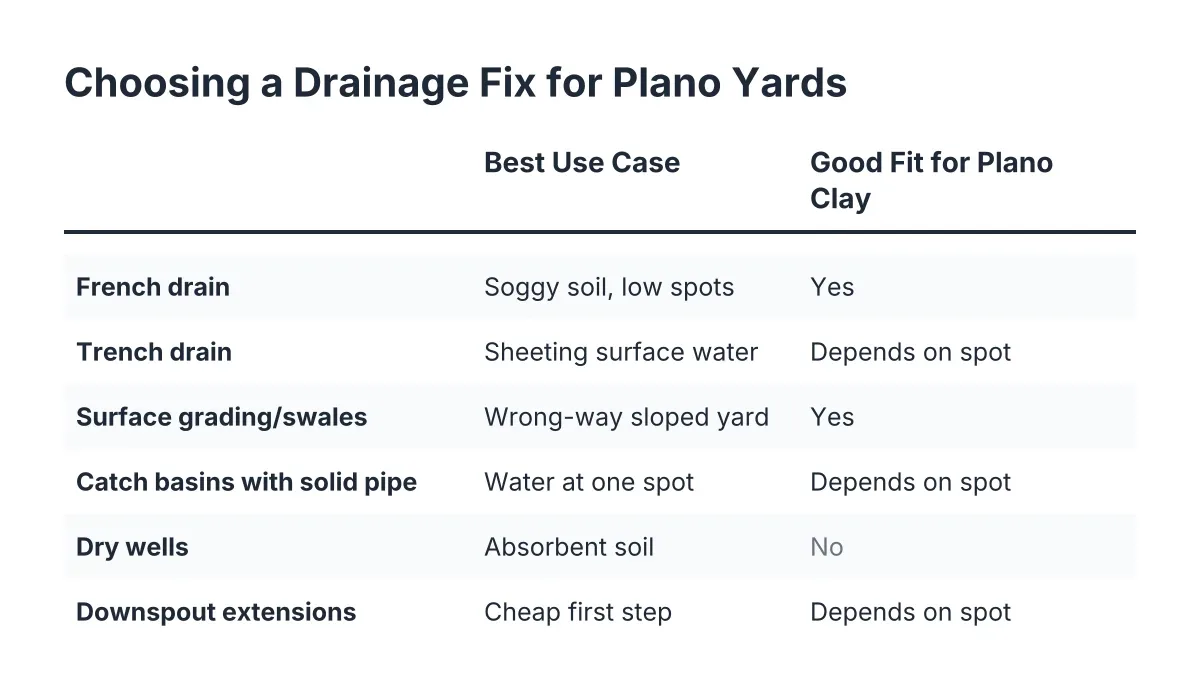
Here is the short version of how a French drain compares with other drainage choices:
- French drain: Best for soggy soil, water collecting along a foundation, or a low spot that never dries. Buried and invisible once the grass grows back.
- Trench drain (channel drain): Best for sheets of surface water crossing driveways, patios, or pool decks. Sits at the surface with a visible grate.
- Surface grading and swales: Best when the yard slopes the wrong way. Reshapes the ground so water flows where you want.
- Catch basins with solid pipe: Best for collecting water at one defined spot, like under a downspout, and piping it away.
- Dry wells: Best in soil that absorbs water. A weak match for most Plano clay.
- Downspout extensions: Best cheap first step when gutters dump water right at the foundation.
The sections below walk through each one, with the trade-offs that matter on a Plano lot.
What a French Drain Does Well, and Where It Falls Short
A French drain solves subsurface water. If your lawn squishes underfoot three days after rain, or water collects along the slab after every storm, water is sitting in the soil. A trench drain cannot fix that, because the water never flows across the surface in a sheet. A French drain intercepts it below grade and carries it off.
The strengths:
- It disappears. Once installed, sod covers the trench and the yard looks untouched.
- It protects foundations. Clay that stays saturated against a slab can contribute to movement over time.
- It handles both soil water and, with a catch basin added, surface runoff in one system.
The trade-offs:
- It costs more than surface fixes because it requires trenching, gravel, fabric, and pipe. The cost of French drain installation depends on trench length, depth, soil conditions, and how hard the exit point is to reach.
- It needs a proper exit point. A French drain that ends in the middle of the yard just moves the puddle.
- Dig-it-yourself versions in clay are hard work. Hand-trenching 40 feet of Plano clay at 18 inches deep is a different job than the online videos filmed in loose loam suggest.
Common French drain pipe sizes for residential work are 3 inch and 4 inch perforated pipe, with 4 inch the usual choice for yard and foundation runs. Undersized pipe clogs faster and backs up in heavy storms, so this is not a place to save a few dollars.
French Drain vs. Trench Drain: The Comparison People Get Wrong
The difference between a French drain and a trench drain comes down to where the water is. A French drain collects water from inside the soil through a buried perforated pipe. A trench drain collects water flowing across a hard surface through a grate set flush with the pavement. They look similar in name and nothing alike in function.
Suppose a homeowner in a 15-year-old Plano neighborhood has two problems: rainwater sheets down the driveway into the garage, and the side yard between the house and the fence stays muddy for a week after rain. In that scenario, the driveway needs a trench drain across its width, and the side yard needs a French drain run to the street or curb. Installing a French drain under the driveway would do nothing for the sheeting water, and a trench drain in the side yard would sit dry while the soil beneath it stayed saturated.
Therefore, match the drain to the water, not the other way around. Surface water moving fast needs a grate. Soil water sitting still needs perforated pipe and gravel.
Drainage Solutions: Comparing French Drains with Other Fixes for the Yard
Beyond trench drains, three other options come up in most Plano drainage conversations. Each works in a specific situation, and each has a failure mode worth knowing before you spend money.
Surface Grading and Swales
Regrading reshapes the soil so water flows away from the house on its own. A swale is a shallow, wide, grass-lined channel that guides runoff toward the street or a drainage easement. When a yard pitch is the root problem, grading fixes the cause instead of managing the symptom.
The limits: grading disturbs established landscaping, and on small Plano lots there may not be room to build enough slope. A swale also stays visible as a dip in the lawn. In addition, regrading around an existing in-ground sprinkler system means heads and lines may need to be lowered or raised to match the new soil level, which adds cost.
Catch Basins with Solid Pipe
A catch basin is a box with a grate that collects water at one spot, then sends it through solid (not perforated) pipe to an exit. It shines under downspouts and at defined low points. Many good drainage systems in Plano combine catch basins for surface water with a French drain for soil water, sharing one discharge line.
The limit: a catch basin only helps where water concentrates. It does nothing for a broadly soggy lawn.
Dry Wells
A dry well is a buried chamber that holds runoff and lets it soak into the surrounding soil. In sandy soil, it works. In Plano clay, the water often has nowhere to go, so the well fills and stays full. For most North Texas lots, a dry well is a last resort for sites with no workable gravity exit point, not a first choice.
Where Does a French Drain Into?
A French drain drains into a legal discharge location, most commonly the street gutter, a curb core, a drainage easement, or daylight at a lower spot on the property. The exit point must sit lower than the entire pipe run so gravity keeps water moving. Without a good exit, the system fails no matter how well the trench was built.
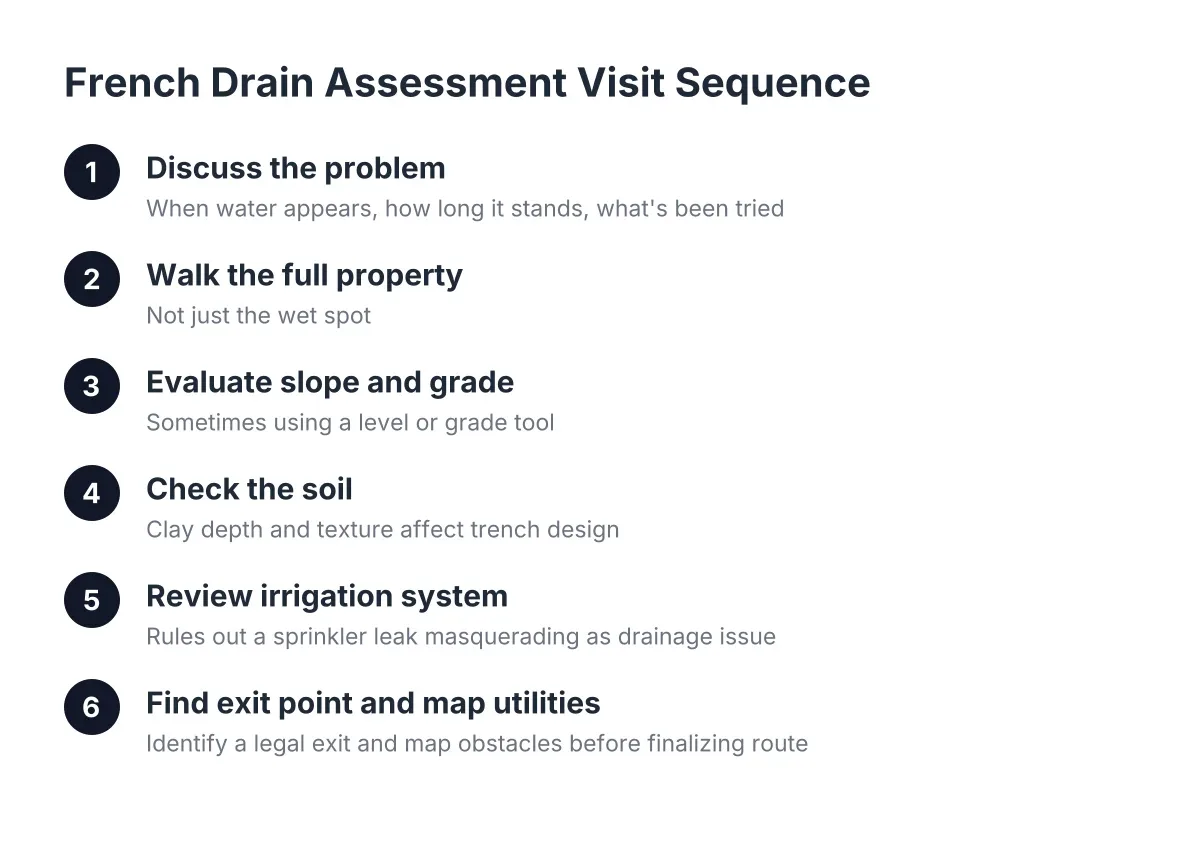
This question decides more projects than any other. Before comparing a French drain with other drainage options, walk your lot and find the lowest workable discharge spot. If the whole yard sits lower than the street and there is no easement, a gravity French drain may not work, and you may need a sump pump system or a different approach. Never discharge onto a neighbor's property; that creates a dispute and can create liability.
As of 2026, Plano and surrounding North Dallas cities have rules about discharging into streets and storm systems, so confirm what your city allows before cutting a curb core.
Can You Install a French Drain Yourself?
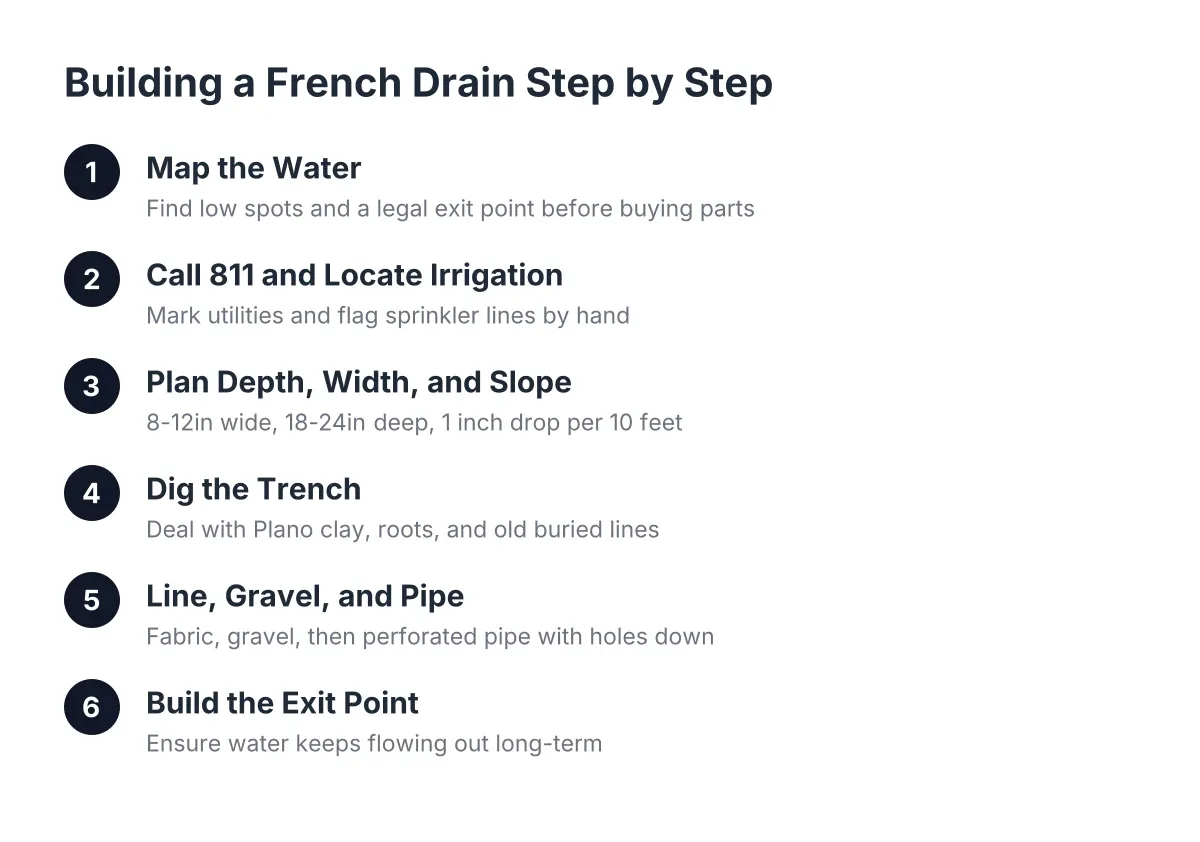
You can install a French drain yourself if the run is short, the soil cooperates, and the slope to the exit point is clear. The basic steps are simple: dig a trench with consistent fall, line it with filter fabric, add gravel, lay perforated pipe with the holes positioned correctly, cover with more gravel, wrap the fabric, and backfill. Kits from big-box stores bundle the fabric, pipe, and fittings.
However, the gap between the steps and the result is where most DIY installs in Plano go wrong. The common failure points:
- Not enough slope. The pipe needs steady fall, roughly a quarter inch per foot, over the whole run. Clay trenches slump and create bellies where water sits.
- Skipping or misusing filter fabric. Clay fines migrate into unprotected gravel and clog the system within a few seasons.
- No real exit point. The pipe ends short of a legal, lower discharge spot, so water backs up.
- Cutting irrigation lines. Trenching through an unmapped sprinkler system slices lateral lines and low-voltage valve wires. On an inherited system with no documentation, you will not know where those lines run until you hit one.
- Undersized pipe or cheap corrugated pipe laid flat. Both reduce flow and invite clogs.
That fourth point deserves emphasis for anyone who just bought a Plano home. Builder-installed irrigation lines rarely follow a predictable path, and the previous owner probably left no map. A sprinkler system contractor can locate zones and lines before any trenching starts, which is cheaper than repairing cut pipe and splicing wire after the fact. Professional french drain installation crews plan the trench route around the irrigation system for exactly this reason.
Check the Sprinkler System Before You Blame Drainage
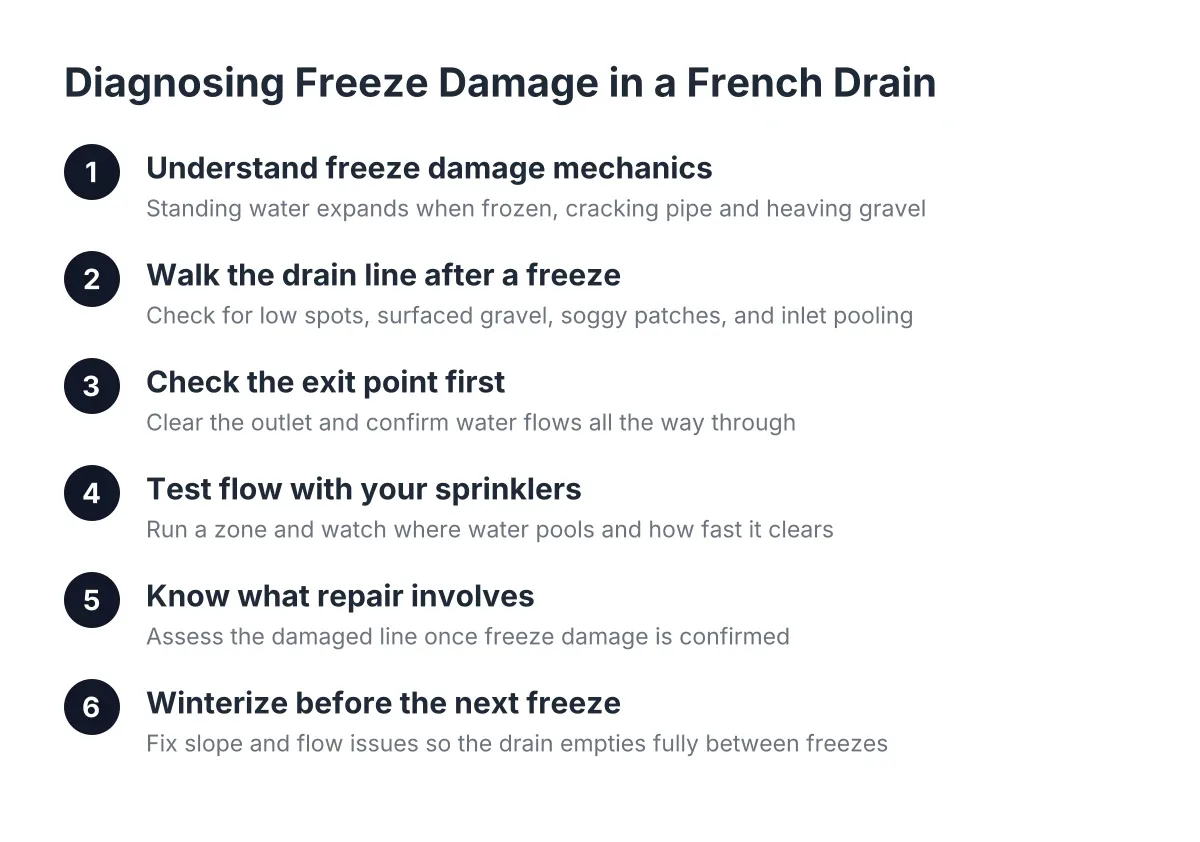
A leaking irrigation system can mimic a drainage problem. A weeping zone valve, a cracked lateral line, or a buried drip line tapped into a spray zone can keep one patch of ground wet for weeks. North Texas clay shifting through summer heat and winter freezes cracks irrigation lines regularly, and underground utility work can crimp a PVC pipe without leaving any visible break.
The waste adds up too. According to U.S. Environmental Protection Agency (EPA WaterSense), a household with an automatic landscape irrigation system that is not properly maintained can waste up to 25,000 gallons of water annually. If your water bill jumped after you moved in and one corner of the yard never dries, suspect the sprinkler system before you price a drain.
A few quick checks before committing to any drainage project:
- Turn the irrigation controller off for a week during dry weather. If the wet spot dries, the problem is a leak, not drainage.
- Learn how to turn off a sprinkler system at the shutoff valve, usually near the backflow preventer, so you can isolate it completely.
- Walk the yard during each zone's run time and look for heads that bubble, gush, or stay wet after the zone shuts off.
- Look for signs of recent digging or cable installation; utility crews sometimes damage irrigation pipe without the homeowner ever knowing.
If those checks point to the irrigation side, a sprinkler repair visit costs far less than a drainage system. If the ground stays wet with the system off, you have a genuine drainage problem and the comparison above applies.
How to Choose the Right Drainage Fix
Start with the water source, then match the solution:
- Gutters dumping at the foundation: downspout extensions first, then a catch basin and solid pipe if extensions are not enough.
- Water sheeting across a driveway or patio: trench drain.
- Yard sloped toward the house: regrading or a swale.
- Soil that stays saturated, or water along the slab: French drain with a proper exit point.
- Wet spot that tracks your watering schedule: sprinkler repair, not drainage.
Weighing a French drain against other drainage choices comes down to three questions. Is the water on the surface or in the soil? Is there a lower, legal place to send it? And is the ground wet because of rain or because of a leaking irrigation line? Answer those three honestly and the right option usually picks itself.
For a short downspout fix or a single catch basin, a capable homeowner can handle the work. For a full French drain in Plano clay, especially on a lot with an undocumented sprinkler system, bringing in a professional protects both the drain and the irrigation lines you cannot see. Complex cases, like water against the foundation or a lot with no gravity exit, warrant a professional assessment before anyone picks up a shovel.
If you need French drain installation, North Dallas Sprinkler Repair can help.
Prefer to talk it through? Call (469) 639-1022 — a quick call is usually the fastest way to get a straight answer for your situation.