What to Expect During a French Drain Inspection and Assessment in Plano, TX
If standing water keeps showing up in the same corner of your yard, you have probably started searching for drainage help. Before anyone digs a trench, a good contractor starts with an inspection. Knowing what to expect during a French drain inspection and assessment makes the whole process less stressful. It also helps you spot the difference between a contractor who does real diagnostic work and one who quotes a price from the driveway. This guide walks Plano, TX homeowners through the full visit: what the contractor looks at, the questions they ask, how they pick a route and an exit point, and how the findings turn into a written plan and estimate.
Why French Drain Inspection Matters More Than the Trench
A French drain is a simple idea. You dig a sloped trench, lay perforated pipe in gravel, wrap it to keep soil out, and give the water somewhere better to go. The hard part is not the digging. The hard part is reading the yard correctly before the digging starts.
Plano sits on heavy North Texas clay. Clay soil absorbs water slowly, holds it for days, and shifts as it swells and dries. That shifting cracks irrigation lines, tilts patios, and changes how water moves across a lot from one season to the next. A drain placed in the wrong spot in clay soil does not fix the problem. It just moves the puddle a few feet.
That is why the assessment visit matters. A contractor who spends 45 minutes walking your property, checking slope, and asking about your sprinkler system will design a drain that works. One who glances at the puddle and names a price is guessing. In clay soil, guessing gets expensive.
What to Expect During a French Drain Assessment Visit
Expect a structured walk-through that lasts 30 to 60 minutes for a typical Plano lot. The contractor inspects the wet areas, traces where water enters and exits the property, checks slope and soil, reviews your irrigation system, and asks about your home's drainage history. The visit ends with a proposed route, an exit point, and the factors that will drive your estimate.
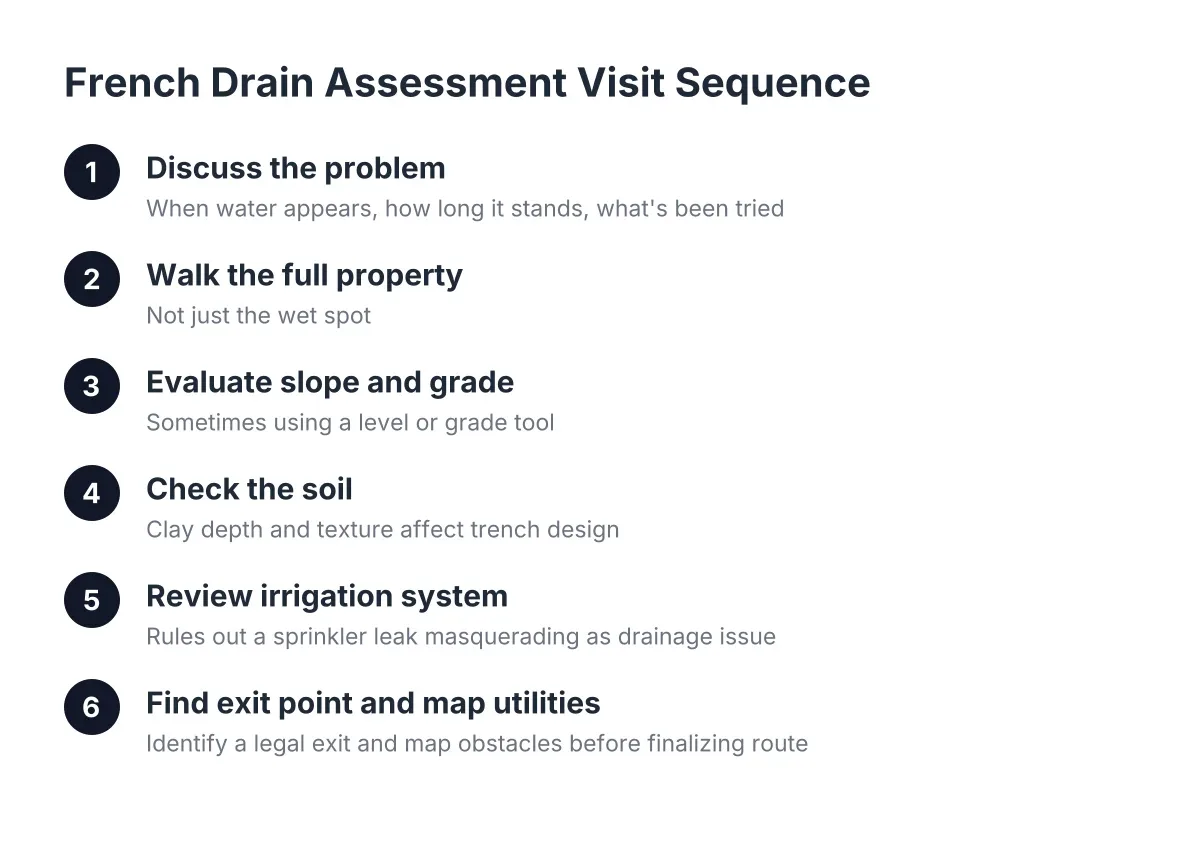
Here is the sequence most thorough assessments follow:
- A conversation about the problem: when water appears, how long it stands, and what you have already tried.
- A full walk of the property, not just the wet spot.
- Slope and grade evaluation, sometimes with a level or grade tool.
- A soil check, since clay depth and texture affect trench design.
- An irrigation system review to rule out a leak masquerading as a drainage problem.
- Identification of a legal, workable exit point for the water.
- Utility and obstacle mapping before any route is finalized.
- A summary of findings and what the written estimate will cover.
Each of those steps exists for a reason. The sections below explain what the contractor is actually looking for at each stage, so you can tell whether your assessment covered the ground it should.
The Questions a Good Contractor Asks First
Before walking the yard, the contractor should ask about history. When did the standing water start? Does it show up after every rain or only after heavy storms? Does it appear when the sprinklers run, even in dry weeks? Has any utility work, cable installation, or fence work happened recently?
That last question matters more than homeowners expect. Underground utility installers sometimes nick or crush irrigation pipe without anyone noticing. Water then seeps out underground for weeks and surfaces as a soggy patch that looks exactly like a drainage problem. If the wet spot appeared around the same time as a trenched cable line or a new fence post, that is a strong clue the fix may be a sprinkler repair, not a drain.
You should also expect questions about your watering schedule. A zone that runs too long on Plano clay can create standing water all by itself, because clay cannot absorb water as fast as spray heads put it down. Sometimes the honest answer after an assessment is a schedule change and a sprinkler head adjustment, not a trench.
Ruling Out a Sprinkler Leak Before Designing a Drain
Expect any careful French drain assessment to include an irrigation check, because a leaking sprinkler line and a drainage problem look identical from the surface. Both produce a patch of lawn that stays wet, grows faster, or turns to mud. The difference is that a drain will never fix a leak; it will just carry wasted water away while your bill climbs.
The numbers behind this are not small. According to U.S. Environmental Protection Agency (EPA WaterSense), a household with an automatic landscape irrigation system that is not properly maintained can waste up to 25,000 gallons of water annually. If your wet spot is actually a cracked lateral line, you want to know before you pay for a trench.
During this part of the visit, the contractor may run each sprinkler zone and watch the suspect area. They look for water surfacing near the wet spot while a specific zone runs, heads that barely pop up because pressure is bleeding out somewhere, and valve boxes holding water. One wrinkle worth knowing: homeowners sometimes tap drip lines into an existing spray or rotor zone and bury them. Years later, a buried drip line splits and leaks underground with no visible source. A good inspector asks whether any drip irrigation was ever added, because that history changes where they look.
In addition, a company that handles both irrigation repair and French drain installation can check both possibilities in one visit. If the problem turns out to be a cracked pipe or a stuck valve, you get a sprinkler valve replacement quote instead of a drainage quote. If the irrigation system checks out clean, you can move forward on the drain knowing the real cause was confirmed, not assumed.
How the Contractor Reads Slope, Soil, and Water Flow
Water obeys gravity, so the assessment is mostly about elevation. The contractor walks the whole lot, not just the problem corner, to see how water travels across it. They note where downspouts discharge, where neighboring lots drain onto yours, and where the grade flattens out and lets water sit.
On many Plano lots, the story is familiar. Builders grade yards to shed water toward the street or an alley, but over 15 or 20 years, clay settles, flowerbed edging traps runoff, and patios or pool decks interrupt the original flow path. The low spot that floods today may not have existed when the house was built.
Expect the contractor to check grade with a level, a string line, or simply practiced eyes on a sloped lot. A French drain pipe needs consistent fall from start to finish, commonly about an inch of drop for every eight to ten feet of run. If your yard cannot provide that fall to a natural exit, the design changes; the trench may need to be deeper at the far end, or the plan may shift toward a sump basin or a different drainage approach.
Soil comes next. The contractor may probe the ground or pull a small plug to see how deep the clay layer sits and how it is draining. Heavy clay affects trench width, gravel volume, and whether the pipe needs a fabric wrap to keep fine sediment from clogging the system over time. These details sound minor, but they are exactly what separates a drain that works for 15 years from one that silts up in three.
Finding the Exit Point: Where the Water Will Go
Every French drain needs a destination, and the exit point is often the hardest part of the design. Expect the contractor to spend real time on this question during the inspection. Water collected by the drain has to discharge somewhere lower than the pipe, and it has to do so legally and without creating a new problem.
Common exit options on Plano lots include:
- Daylighting at the curb or street, where the pipe discharges into the gutter flow.
- Tying into an existing yard drain or area drain system that already carries water off the lot.
- A pop-up emitter in a lower section of the yard that releases water over a wide area.
- A dry well or gravel pit, used when no surface exit exists, though these fill slowly in clay.
What a contractor should never propose is aiming the discharge at a neighbor's yard or the base of a fence line. That moves your problem onto someone else and can create a dispute. If your lot is flat or sits lower than everything around it, the exit conversation gets harder, and the honest answer may involve a sump pump or a different solution entirely. A contractor who raises these complications during the assessment is doing their job; one who waves them off is setting up a callback.
The exit point also interacts with your irrigation system. The trench route and the discharge line both have to cross or avoid existing sprinkler pipe. This is where hiring a sprinkler system contractor who also installs drains pays off, because they can locate and protect irrigation lines rather than discovering them with a trencher blade.
What You Should Expect During the French Drain Estimate Conversation
At the end of the French drain assessment, expect a clear explanation of what the contractor found and what the written estimate will include. You should hear the proposed route described in plain terms, the planned exit point, the trench depth and length, and the materials involved: pipe type, gravel, and fabric. If the contractor also found irrigation issues, those should appear as separate line items, not buried in the drain price.
Cost factors the estimate should reflect, as of 2026, include:
- Trench length and depth, since digging is most of the labor.
- Soil conditions, because dense clay slows excavation.
- Obstacles along the route, such as tree roots, sidewalks, fences, or buried lines.
- The exit point, since a curb core or a long discharge run adds work.
- Access, because a backyard behind a narrow gate limits equipment and raises hand-digging time.
- Repairs to any sprinkler lines that must be cut and rejoined along the route.
Be cautious of any quote delivered before utilities are located. Texas law requires calling 811 before digging, and a professional builds that step into the schedule. Expect the contractor to explain that marking takes a few business days and that the final route may shift slightly once gas, electric, and communication lines are flagged.
For example, suppose a homeowner near Legacy and Coit has water pooling along the back fence after every storm. In that scenario, a typical French drain inspection might find that the lot's grade traps runoff behind a raised flowerbed, that one sprinkler zone runs twice as long as the clay can absorb, and that the only workable exit is a 60-foot run to a pop-up emitter near the side yard. The estimate would then cover the trench, the pipe and gravel, rerouting one irrigation lateral, and a watering schedule adjustment. That is an illustrative case, but it shows how the pieces of the assessment connect into one plan.
Questions Worth Asking Before You Sign
The assessment visit is also your chance to interview the contractor. Decision-ready homeowners get better outcomes when they ask specific questions and listen for specific answers. Vague responses on any of these are a reason to slow down.
- Where exactly will the water exit, and why is that spot lower than the whole pipe run?
- How will you protect or reroute my sprinkler lines along the trench?
- What slope will the pipe have, and how will you verify it during installation?
- Will the pipe be wrapped or sleeved to keep clay fines out?
- Who calls 811, and when?
- How will you restore the lawn over the trench?
- What maintenance will this drain need, and how often?
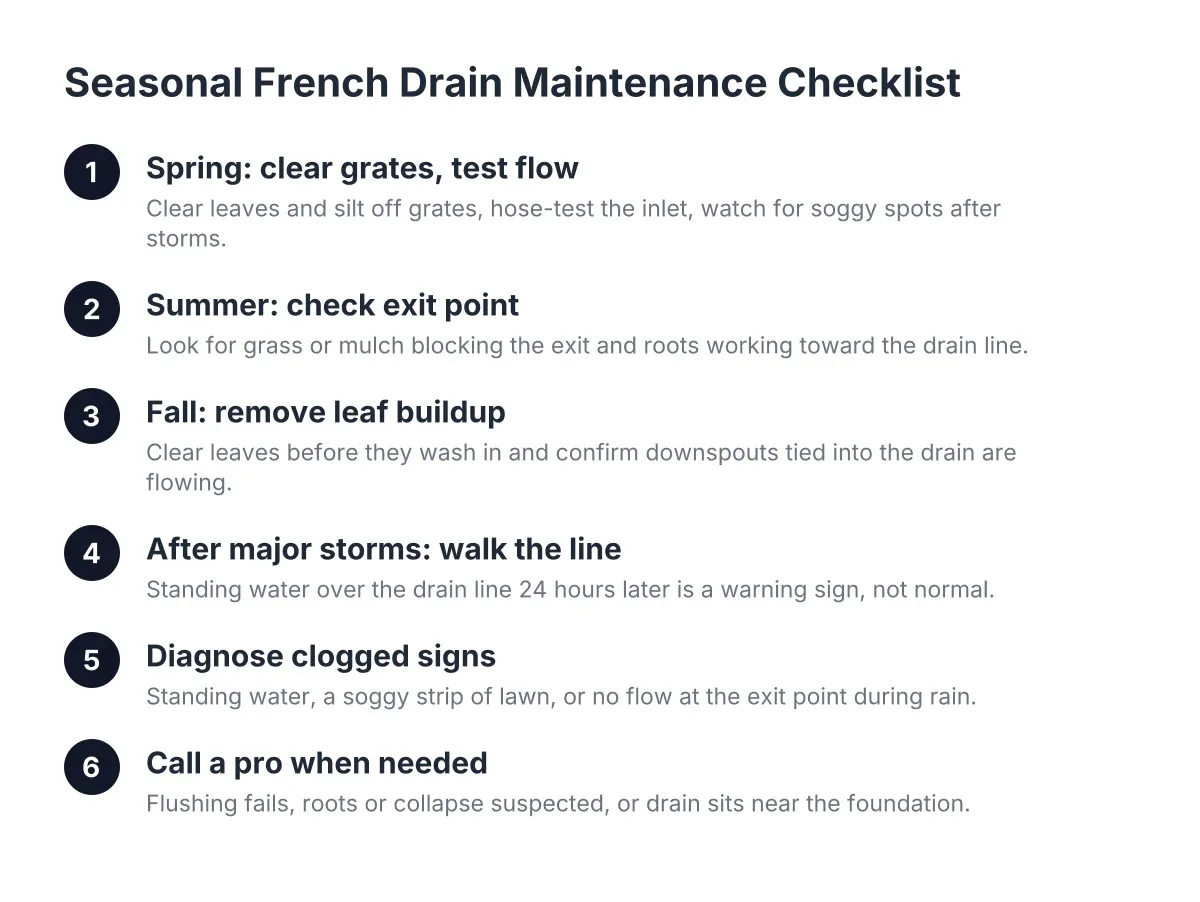
That last question matters for the long run. A French drain in clay soil is not install-and-forget. Inlet grates need clearing, pop-up emitters need checking, and silt builds up over years. Searching for french drain cleaning near me after the system clogs is the expensive version of this lesson; asking about maintenance during the assessment is the cheap one. Some homeowners fold drain checks into the same seasonal visits they already book for sprinkler startup and shutdown, which keeps one company familiar with everything buried in the yard. If you would rather not track it yourself, a standing arrangement with a provider that handles french drain maintenance near me searches for you solves it once.
Where the Assessment Can Change the Plan
Honest assessments sometimes end somewhere unexpected, and you should welcome that. Here are the most common pivots.
First, the problem turns out to be irrigation. A cracked line, a weeping valve, or an overlong run time on clay soil was creating the standing water. The fix becomes a sprinkler system repair and a schedule change, which costs a fraction of a trench. According to U.S. Environmental Protection Agency (EPA WaterSense), a well-managed irrigation system can reduce a household's irrigation water use by 15 percent, or nearly 7,600 gallons annually, so getting the watering side right pays off on its own.
Second, the problem needs more than a French drain. Water against a foundation, a lot that sits below all its neighbors, or runoff volume from a large roof can exceed what one gravel trench handles. In those cases a surface drain system, regrading, or a sump setup may belong in the plan. A drain alone would underperform, and you deserve to hear that before the digging starts.
Third, the problem is partly the gutters. Downspouts that dump roof water ten feet from the wet spot are often half the cause. Extending or piping downspouts into the new drain line is a cheap addition during installation and a common recommendation at the assessment stage.
One honest limitation: no assessment sees everything underground. Buried surprises like old construction debris, unmapped lines, or roots can still shift the final scope once the trench is open. A professional will tell you that upfront and explain how changes get priced if they occur. For foundation-related water problems or suspected plumbing leaks under the slab, bring in a foundation or plumbing specialist as well; drainage work treats surface and soil water, not slab leaks.
The Bottom Line for Plano Homeowners
A French drain fixes standing water only when the design matches the yard, and the design comes from the assessment. Now you know what to expect during the French drain inspection: a real conversation about history, a full walk of the lot, slope and soil checks, an irrigation review to rule out leaks, a defensible exit point, and an estimate built on visible factors rather than a guess from the curb.
Use that knowledge as a filter. If an assessment skips the sprinkler check, never mentions 811, or cannot explain where the water will exit, keep looking. If it covers the ground described here, you have likely found a contractor who will still look good when the first big North Texas storm tests the trench.
If you need sprinkler repair in Plano, TX, North Dallas Sprinkler Repair can help.
Prefer to talk it through? Call (469) 639-1022 — a quick call is usually the fastest way to get a straight answer for your situation.