How Much Does French Drain Installation Cost?
How much does French drain installation cost? The honest answer depends on three things: how long the drain run needs to be, how hard the digging is in your yard, and where the water has to go once the drain collects it. Anyone who gives you a firm number before walking your property is guessing. This guide explains each factor in plain terms, so you can look at your own yard and understand which way your price will lean. By the end, you will know exactly what to have ready to get a real, accurate number from a contractor.
What Drives the Cost of French Drain Installation
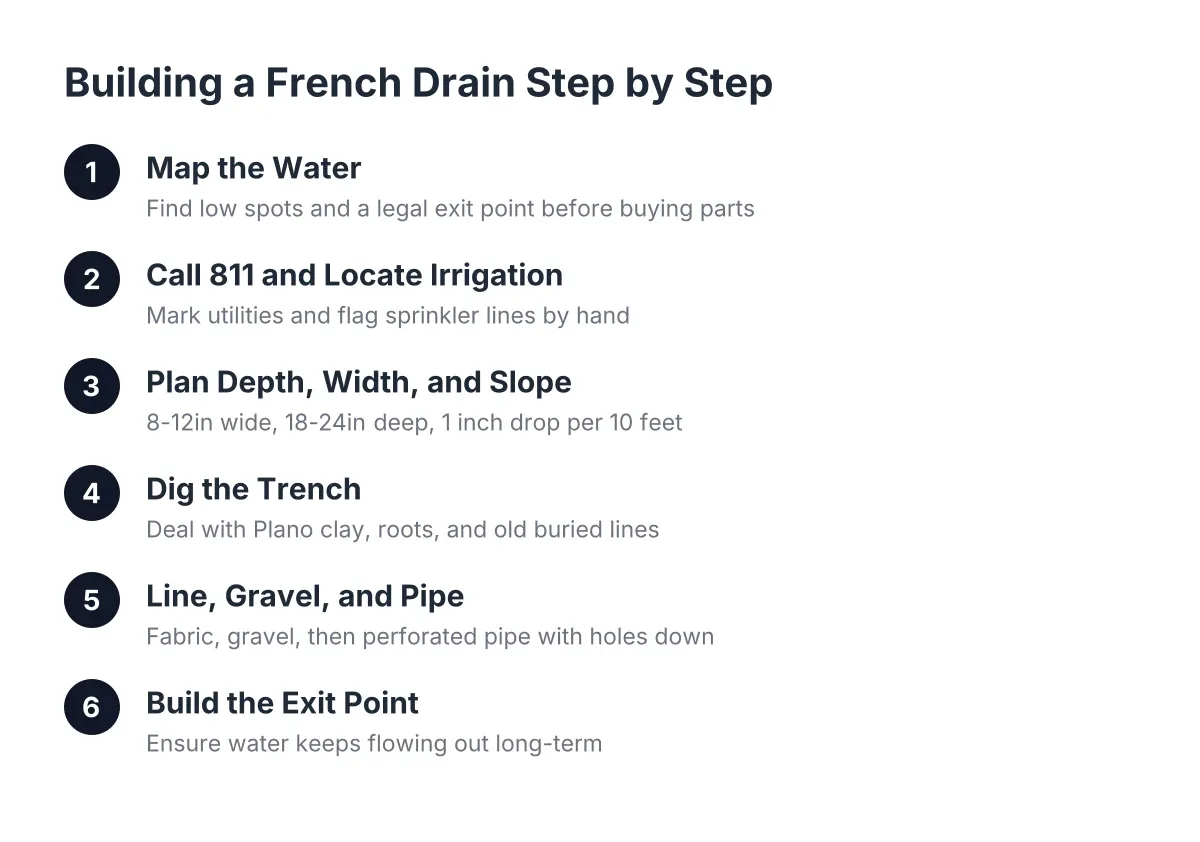
A French drain is a gravel-filled trench with a perforated pipe inside. Water soaks into the trench, enters the pipe, and flows away from the problem spot. The idea is simple. The price swings come from what it takes to dig that trench and route that pipe on your specific lot.
Length of the Drain Run
This is the biggest factor. A drain that solves a soggy corner near one flower bed is a short run. A drain that has to carry water from the back fence, along the side of the house, and out to the street is a long one. More feet means more digging, more pipe, more gravel, and more labor. You can estimate your side of this one yourself: walk the path the water would need to travel and pace it off. Short and direct keeps the price down. Long and winding pushes it up.
Soil Conditions and Digging Difficulty
Plano sits on heavy North Texas clay. Clay is exactly why many yards here hold water in the first place, and it is also harder to dig than loose soil. Dry clay in late summer can be close to concrete. Wet clay is heavy and slow to move. Rocky patches, old construction debris, and compacted fill all add time. If your yard digs easy, the trench goes fast and the labor cost stays lower. If a shovel bounces off your soil in August, expect the work to take longer.
Depth and Width of the Trench
A shallow surface drain that redirects runoff is a smaller job than a deep drain protecting a foundation. Deeper trenches mean more soil removed, more gravel to backfill, and more careful grading so the water actually flows the right direction. The pipe needs a consistent downhill slope from start to finish. If your yard is flat, the trench has to get progressively deeper to create that slope, which adds digging even on a short run.
Obstacles in the Path
Trenches rarely get a clear path. Tree roots, fences, patios, walkways, and existing irrigation lines all sit between the water problem and the discharge point. Cutting through or tunneling under a concrete walkway costs more than trenching through open lawn. Working around a mature tree's roots takes care and time. As a sprinkler system contractor, we map the irrigation lines before digging, because a trench that slices through a lateral line turns one project into two. If your drain path crosses hardscape or runs near big trees, plan for the higher end.
Where the Water Discharges
Collected water has to exit somewhere: daylight at a lower spot in the yard, a curb outlet, or a dry well. A natural downhill exit close by is the cheap scenario. If the nearest legal discharge point is far away, or if your lot has no natural fall and needs a dry well or a sump setup, the scope grows. Stand in your yard after a rain and look for where water already wants to go. If there is an obvious low exit, you are on the lucky side of this factor.
Surface Restoration
After the trench is backfilled, something has to go back on top. Grass seed over the trench line is the simple version. Replacing sod, resetting pavers, or patching a bed of decorative rock adds material and labor. Some homeowners handle restoration themselves to trim the quote. Decide up front how finished you want the surface to look, because it changes the number.
Cost Factor Table
| Factor | Pushes the price down when… | Pushes it up when… |
|---|---|---|
| Drain length | The run is short and direct | Water must travel across most of the lot |
| Soil and digging | Soil is loose and digs easily | Dry or wet clay, rocks, or compacted fill slow the trench |
| Trench depth | A shallow surface drain solves the problem | The drain must sit deep, or a flat yard needs extra depth for slope |
| Obstacles | The path is open lawn | Roots, concrete, fences, or irrigation lines sit in the way |
| Discharge point | A natural downhill exit is nearby | The exit is distant or the lot needs a dry well |
| Restoration | You accept seed over the trench or handle it yourself | Sod, pavers, or rock beds must be fully restored |
How to Get an Accurate French Drain Installation Estimate
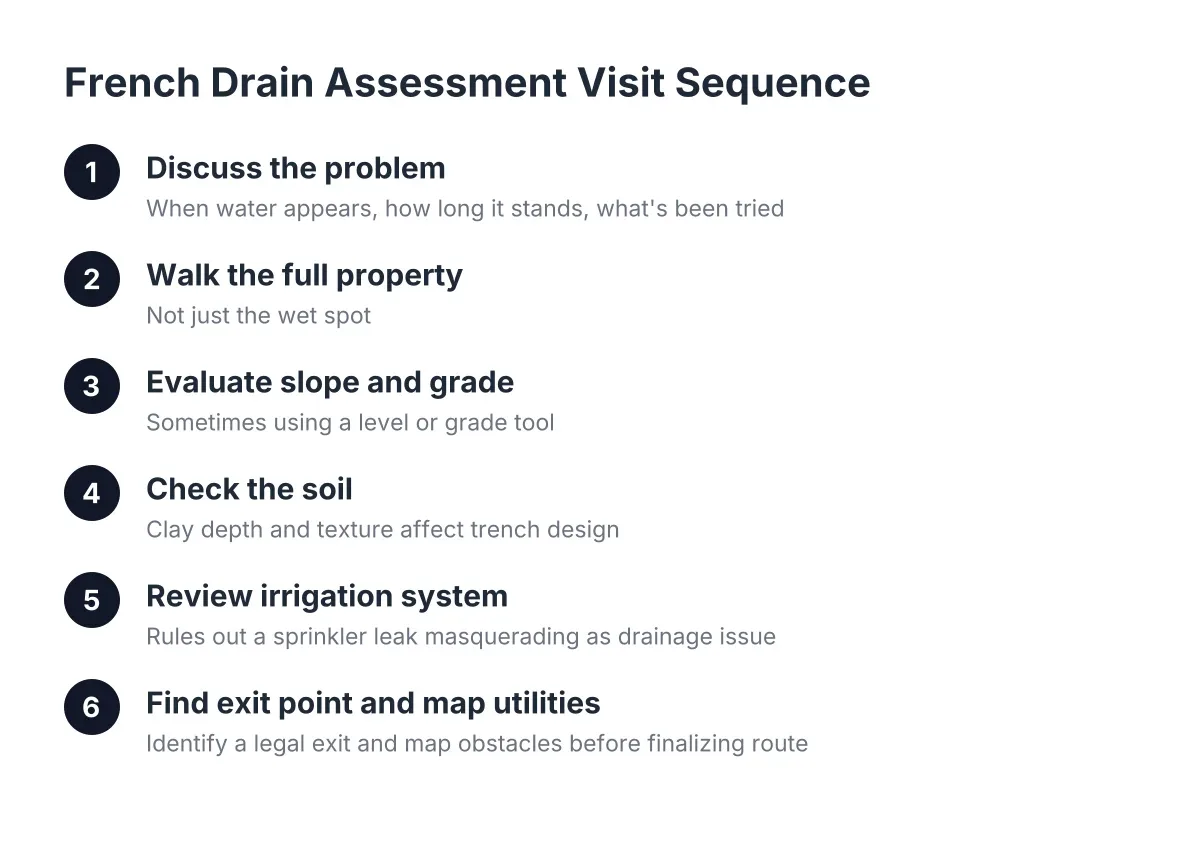
The cost of French drain installation only becomes a real number after someone looks at your yard. Here is how to make that visit productive and how to judge the quote you get back.
Have this ready before the estimator arrives:
- Photos or video of the problem during or right after rain. Standing water tells the story better than a dry yard on a sunny day.
- A rough idea of where your irrigation lines and valves run. If you do not know, say so. A good contractor will locate them before digging.
- Your preference on surface restoration. Seed, sod, or back to exactly how it looked.
- Any past drainage work. Old buried pipes change the plan.
A good quote for French drain installation should spell out the trench route and length, the depth, the pipe and gravel materials, where the water will discharge, who handles restoration, and what happens if the crew hits something unexpected underground. If a quote is just one number on a page with no route or depth, ask for the detail. You cannot compare vague quotes.
Estimates differ between providers for honest reasons. One contractor may plan a deeper trench with more gravel. Another may route the pipe a shorter way that requires cutting a walkway. One includes full sod restoration, another leaves bare dirt. When two quotes are far apart, the difference is usually scope, not greed. Ask each contractor to walk you through their route and depth, then compare the plans, not just the totals.
Ways to Keep the Cost Down
You cannot change your soil, but you can control several real levers.
- Fix the problem while it is small. A soggy corner handled this year is a short drain. The same water left to pool against the foundation for two more years can become a deeper, longer, more urgent project.
- Get two or three detailed quotes. Not to chase the lowest number, but to see different routes and scopes. Sometimes one contractor spots a shorter path to daylight that cuts the trench length.
- Choose a simpler discharge if your yard allows it. If water can exit downhill to a legal low point, skip the dry well.
- Handle restoration yourself. Spreading soil and laying sod over the trench line is work most homeowners can do, and it comes off the quote.
- Keep your irrigation system mapped and marked. Knowing where lines run speeds up the trench plan and avoids repair add-ons. If a sprinkler line does get damaged during any yard project, a prompt sprinkler repair keeps a small cut from becoming a bigger leak under the new drain.
Cost Questions People Ask
What does French drain installation cost near me in Plano?
Local conditions set the local price. Plano's clay soil makes trenching slower than in sandy regions, and many lots here are flat, which means extra digging to create slope. The only way to get your number is an on-site look at your drain route, depth, and discharge point. Two or three local quotes with detailed scopes will show you the realistic range for your yard.
Why do quotes for the same yard come back so different?
Because each contractor is pricing a different plan. One may route the drain forty feet through open lawn; another may route it twenty feet under a walkway. Depth, gravel quantity, pipe type, and restoration all vary too. Compare the written scopes line by line before comparing totals.
Is a French drain cheaper than fixing the damage water causes?
Usually, yes, and often by a wide margin. Water that pools against a slab in North Texas clay contributes to soil swelling and shrinking, which stresses foundations. Drainage work is yard work; foundation work is structural work. Solving the water problem early is the budget-friendly path.
Can I lower the price by digging the trench myself?
Some contractors will price a labor split, but ask before you grab a shovel. The trench needs consistent slope and the right depth, and a trench dug wrong gets re-dug. Where homeowner labor reliably saves money is on the surface: hauling spoil, spreading topsoil, and laying sod after the drain is in.
The Bottom Line
French drain pricing comes down to length, digging difficulty, and where the water exits, and all three live in your specific yard. Gather two or three detailed quotes that spell out route, depth, and restoration, then compare the plans rather than just the totals. Once you see the scopes side by side, the right number for your yard becomes clear.
If you need French drain installation, North Dallas Sprinkler Repair can help.
Prefer to talk it through? Call (469) 639-1022 — a quick call is usually the fastest way to get a straight answer for your situation.